Ant Group Open-Sources LingBot-Touch to Give Robots a Shared Sense of Touch
Robbyant’s tactile model turns signals from three sensor types into one shared language, so touch skills can move between robotic hands.

November 13, 2026 by Dr Maulik Vyas
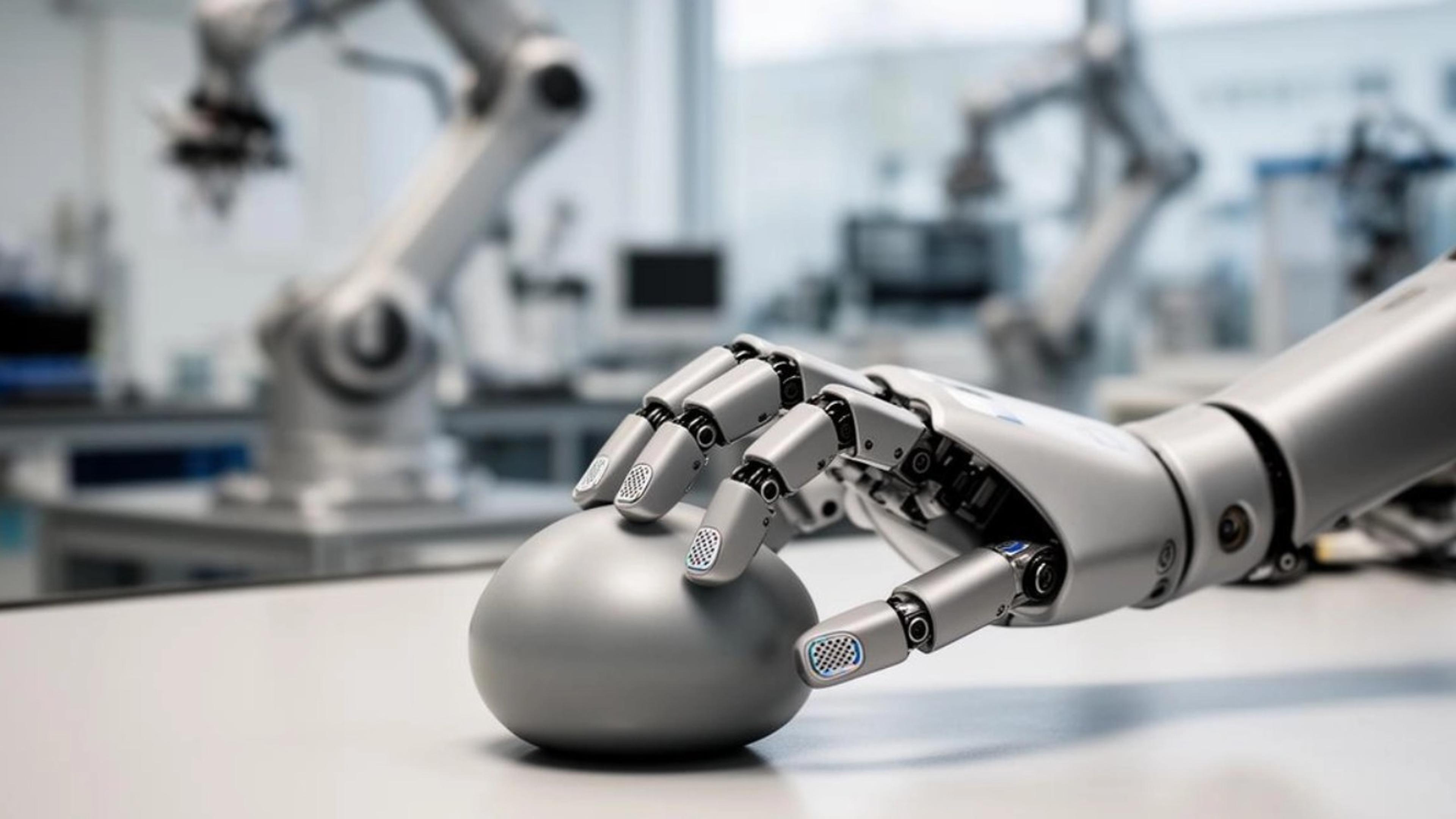
Robbyant, the embodied AI company within Ant Group, has open-sourced LingBot-Touch, a tactile foundation model designed to give robots a touch sense that works across different sensors and different robotic hands. The company announced the release on Nov. 10, and the model, code and technical report are available on Hugging Face and GitHub.
The same physical contact can produce significantly different raw signals depending on the sensor used. To enable learning of such physical contacts in a sensor-agnostic manner, three common sensing principles for tactile perception are supported: magnetic tactile sensing, visual tactile sensing and piezoresistive sensing. All of these sensing principles are mapped to a shared fingertip space, and contact locations and force distributions are modeled over time. In order to enable action models to process such tactile tokens in a sensor-agnostic manner, different encoding pathways are defined for each of the aforementioned sensing principles.
The pre-training dataset is of almost 5,000 hours of real-world tactile interaction data from numerous sources can include interaction from human wearing tactile-gloves, and human-operated teleoperated dexterous-hand(s). LingBot-Touch specifically targets the class of fine manipulation tasks, e.g. turning pages of a book, unscrewing a bottle cap, and recognition of a Mahjong tile.
Robbyant used 26 real world manipulation tests, using 2 dexterous hands (Sharpa Wave, XHand) and 4 action models (LingBot-VLA, π0.5, Diffusion Policy, T-Rex). cross the four action models, the average success rate rose by about 14 to 26 percentage points when the touch layer was used, compared with using no tactile input. In one representative test, using T-Rex with Sharpa Wave to unscrew a bottle cap, the success rate was 56.25 percent without touch, 62.5 percent with raw sensor signals and 90 percent with the unified tactile representation.
Robbyant further showed transfer to new hardware, such as the magnetic sensor on XHand not being included in the tactile data used for pre-training. All 26 test tasks were performed using a lite version of the touch layer, with approximately 5.3M parameters, adding between 0.13 percent and 0.16 percent to the size of the downstream action models it supports.
Note that the reported results are all from internal tests by Robbyant. The announcement does not say how many trials were performed for each of the individual tasks and hence will have to await results from independent reproduction and test on other hands or sensors.
More articles on this topic
268 articles ReportWhat it Really Costs to Own a Personal Assistant Robot at Home
 ReportArrive AI Invests in Ottonomy with Plans for 50 Autonomous Delivery Robots
 ReportCaltech Robot Builds Structure in Space for First Time
 ReportGritt Partners with MasTec to Deploy AI-Powered Construction Robots Across US Solar Projects
 ReportPrimeBOT Produces Its 10,000th Personal Robot After Doubling Output in Just 14 Days
 ReportGoogle DeepMind Tests Gemini Robotics 2.5 on Mercedes-Benz Production Lines With 96 percent Success Rate
 ReportMIPS Unveils RISC-V Platform to Deliver Precise Motor Control Inside Humanoid Robot Joints
 ReportImpossible Metals Tests Autonomous Underwater Robot to Collect Minerals at 4,000-Metre Depth
 ReportWhy Industrial Data is Becoming the New Strategic Asset in the AI Race
 ReportRobotic Systems Are Bringing Greater Precision to Veterinary Surgery
 ReportEvery Brick, Even the Curves—Monumental Shows What Its Robots Can Build
 ReportServe Robotics Launches Physical AI Services to Supply Technology to Other Robot Makers
BUSINESS NEWS WEEKLY LETTER
The Weekly Letter for Robotics Professionals, Summarizing the Most Important Industry Moves, Launches, Deals and Signals.