Best Humanoid Robots 2026
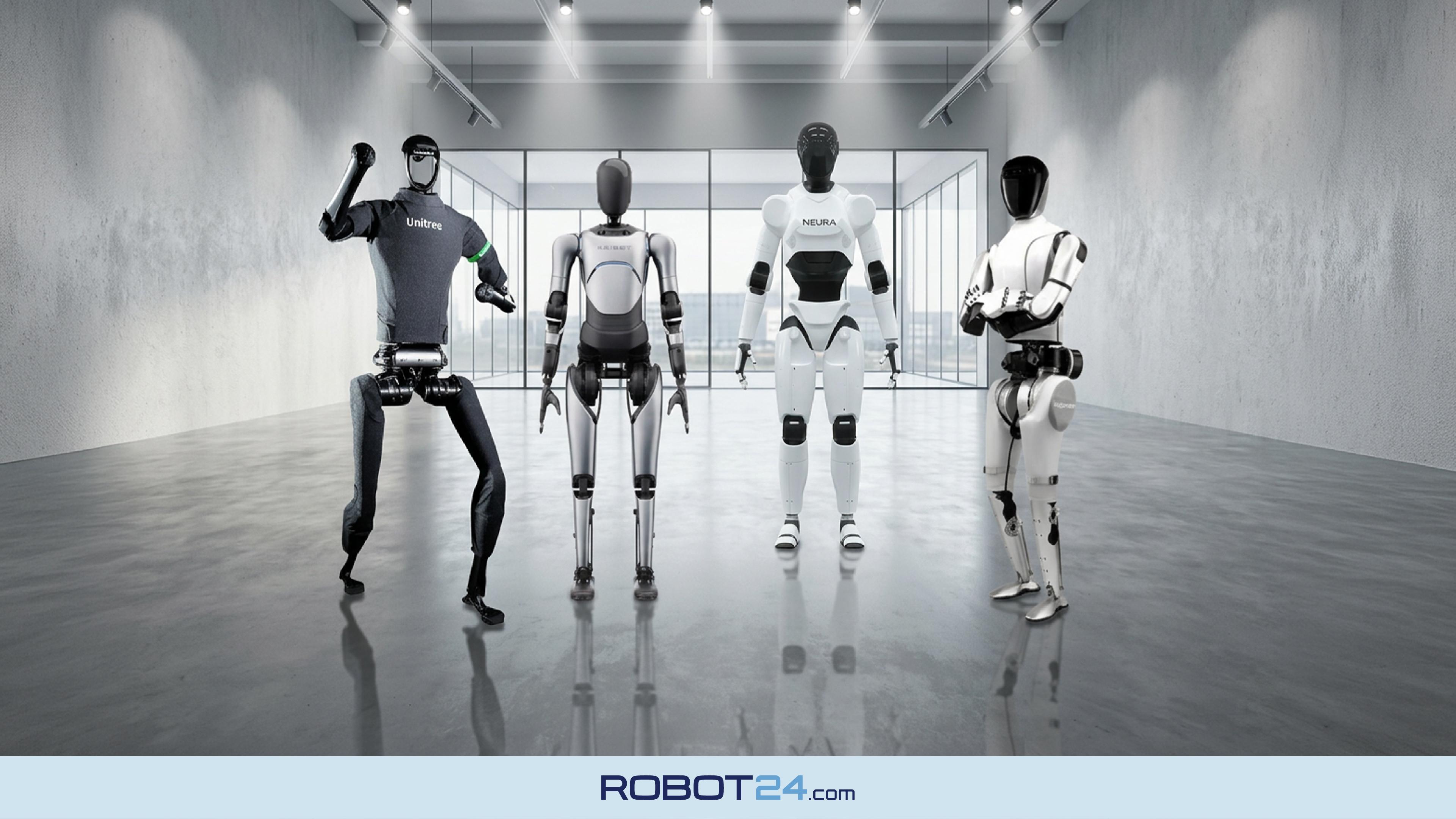
ROBOT24.com ranks four full-size humanoids for research and development, weighing what they can do against how easily labs can put them to work.

November 17, 2026 by Business Desk Team
Introduction
A robot able to run at the speed of 3.6 meters per second would suit well a research team focusing on studying balance. The lab working on teaching a robot to interact with unknown objects would benefit more from having touch-sensing fingertips. However, in case of the need to repeat an experiment many times, control access would play a bigger role than both previous specifications.
Using ROBOT24.com market research data, we rank the AgiBot A2 Ultra, NEURA Robotics 4NE1 Gen 3, RobotEra STAR1 and Unitree H1-2 on their manipulation capabilities, developer access and availability, mobility, compute and sensing, and endurance. The AgiBot A2 Ultra ranks as the best among all of them, while the H1 got the top score for its development platform.
At A Glance
| Rank | Robot | Overall score | Standout specification | Best suited to |
|---|---|---|---|---|
| 1 | AgiBot A2 Ultra | 81/100 | 19 degrees of freedom in its tactile hands; 512 Nm listed peak joint torque | Dexterous manipulation and imitation learning |
| 2 | NEURA Robotics 4NE1 Gen 3 | 76.5/100 | Listed 6–8 hours of runtime and dual hot-swappable batteries | Long data collection sessions and research using NVIDIA tools |
| 3 | RobotEra STAR1 | 74/100 | 55 degrees of freedom, 275 TOPS of onboard compute and a listed 3.6 m/s running speed | Dynamic locomotion and whole-body control |
| 4 | Unitree H1 | 72.5/100 | ROS 2 support, an SDK and Python and C++ APIs | Locomotion, reinforcement learning and reproducible experiments |
The robots behind the rankings
1. AgiBot A2 Ultra: Best for dexterous manipulation
A2 Ultra has the best manipulation rating in the bunch, owing to its dexterous hands that have 19 degrees of freedom and tactile sensing at fingertips. The database says that it has 200 TOPS NVIDIA Jetson Orin computing capability, along with 3D LiDAR, stereo cameras, and force/torque sensors. This makes it an excellent candidate for research involving vision, touch, and motion.
The downside is that of endurance. According to the database, it has an endurance of two hours, along with a 700 Wh hot-swappable battery. Laboratories planning to conduct multiple experiments in sequence should verify the hands, sensors, and additional batteries in the quoted package.
2. NEURA Robotics 4NE1 Gen 3: Best for long data collection sessions
Overall score: 76.5/100
4NE1 Gen 3 achieves the highest endurance rating, with specified runtime of six to eight hours and two interchangeable batteries. Sensor skin, overall perception, and teleoperation feature of the robot make it suitable for teams documenting demos for imitation learning tasks. The database also indicates NVIDIA Isaac GR00T compatibility.
Availability is the only criteria that should be considered. According to the database, the platform is currently available at the preorder or early commercial availability level. Researchers having a deadline for conducting their experiments need to check the availability of the robot first.
3. RobotEra STAR1: Best for dynamic locomotion
Overall score: 74/100
STAR1 scores the highest in locomotion metrics. The robot is listed with 55 degrees of freedom, a speed of 3.6 m/s, and running, jumping, and landing capabilities. In addition, its 20 kg payload capacity may qualify it for hybrid locomotion tasks involving both walking and handling objects.
There is no mention of an SDK or ROS interface for this particular robot. It is necessary to verify which joints can be controlled by the user, the sensor data available for collection, and the ability to deploy custom controllers before requesting quotes.
4. Unitree H1-2: Best for documented developer access
Overall score: 72.5/100
The H1-2 receives the best score in development ecosystem category. ROS 2 compatibility, SDK, and APIs in Python and C++ allow labs working with their own robotic software to start from a proven base. The declared maximum speed of 3.3 m/s and the use of both LiDAR and depth sensors make the robot well suited for studies on locomotion and reinforcement learning.
Overall lower score of the H1-2 is due to fewer capabilities for manipulation, absence of AI-specific processor in the specifications and two-hour battery runtime. Dexterous hands are not standard, thus the teams interested in grasping need to be sure of their presence before comparing costs.
The best fit depends on the goal
The options are A2 Ultra for tactile manipulation, 4NE1 Gen 3 for prolonged recordings, STAR1 for dynamic body movements, or H1-2 if the software interface matters more to you. Before purchase, ensure that the supplier demonstrates a single representative experiment using both the hardware and software mentioned in the quote. This will give you an idea about the availability of any feature from the list of specifications.
Ranking explained
| Parameter | What we assess | Weight |
|---|---|---|
| Manipulation and dexterity | Hand articulation, tactile sensing, payload, arm capability and documented tasks. | 25% |
| Development ecosystem and availability | SDK, ROS 2 and API access, framework integration, availability and lead time. | 25% |
| Locomotion and physical performance | Speed, joint torque, degrees of freedom, terrain capability and documented fall recovery. | 20% |
| AI compute and perception | Onboard compute, vision, LiDAR, force and torque sensing, and sensor coverage. | 15% |
| Working endurance | Runtime, battery capacity and how batteries can be replaced between sessions. | 15% |
Score breakdown
| Criterion | AgiBot A2 Ultra | NEURA 4NE1 Gen 3 | RobotEra STAR1 | Unitree H1 |
|---|---|---|---|---|
| Manipulation and dexterity (25%) | 9 | 8 | 8 | 6 |
| Development ecosystem and availability (25%) | 8 | 7 | 6 | 10 |
| Locomotion and physical performance (20%) | 8 | 6 | 9 | 8 |
| AI compute and perception (15%) | 9 | 8 | 8 | 6 |
| Working endurance (15%) | 6 | 10 | 6 | 5 |
| Weighted total | 81/100 | 76.5/100 | 74/100 | 72.5/100 |
Each robot receives a score out of 10 for the five criteria, which is converted into a weighted total out of 100. Only capabilities documented in Robot24.com’s Market Research Database are credited.
More articles on this topic
59 articles ReportBest Humanoid Robots for Warehouses 2026
 ReportBest Humanoid Robots You Can Actually Buy 2026
 ReportThe Most Deployment-Ready Humanoid Robots 2026
 ReportThe Best Robots for Interactive Art Galleries and Museum Exhibits 2026
 ReportThe Best Delivery Robots for Serving Several Tables in One Trip 2026
 ReportBest Robots for Serving Drinks at Events
 ReportBest Robots for Answering Product Questions in Showrooms 2026
 ReportBest Robots for Multilingual Reception Desks 2026
 ReportBest Full-Size Humanoids for Live Brand Launches and Events 2026
 ReportThe Best Robots for In-Store Promotions 2026
 ReportThe Best Robots for Sweeping Covered Loading Bays 2026
 ReportBest Compact Humanoids for Staffed Live Demonstrations
BUSINESS NEWS WEEKLY LETTER
The Weekly Letter for Robotics Professionals, Summarizing the Most Important Industry Moves, Launches, Deals and Signals.