Robots In LA Can Now Deliver Food To Doorsteps. Here’s How.
The company says its Los Angeles fleet has grown 11-fold since 2024, while restaurants report growing use of the robots for short-distance orders.

September 7, 2026 by Vaishnavi
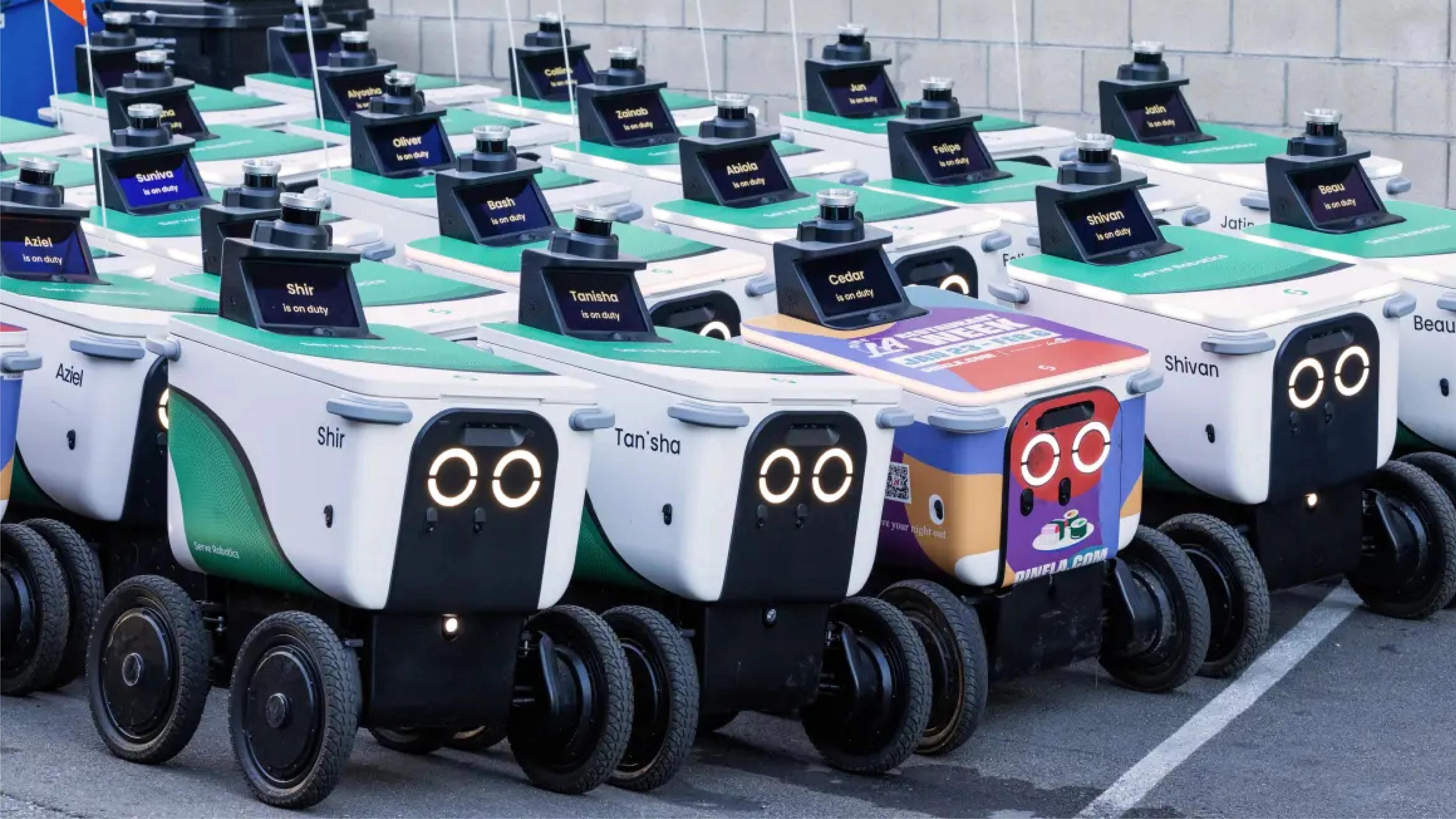
LOS ANGELES: Serve Robotics’ delivery robots are now operating in 40 Los Angeles neighborhoods, up from just two in 2023.
The company has deployed more than 500 robots across the city, giving it a much larger presence in the local restaurant-delivery market.
Serve’s third-generation robots use cameras, lidar and onboard computing to navigate sidewalks and surrounding streets. The company also uses remote operators to assist when robots encounter situations they cannot handle on their own. Serve Robotics’ description of its delivery robots
The service is mainly designed for short-distance deliveries. Serve has said its robots can help reduce the cost of last-mile delivery, although the company still relies on people to monitor and support the machines when needed.
Getting more robots onto city sidewalks has not been straightforward. The Los Angeles Times reported concerns over pedestrian accessibility and the impact of delivery robots on crowded sidewalks. Other cities have also introduced restrictions as the technology expands. Los Angeles Times report on the growing fleet and sidewalk concerns
Serve’s Los Angeles fleet is part of a wider expansion. The company operates across multiple U.S. markets and has continued adding delivery partners. In August, Serve announced a partnership with Grubhub that will bring its robots to orders in Los Angeles, Chicago and Alexandria, Virginia. Reuters report on Serve’s Grubhub partnership
The robots still cannot handle every type of delivery. Human intervention is sometimes required, while conventional delivery vehicles remain necessary for larger orders, longer trips and deliveries that involve entering buildings.
Serve is also expanding beyond food. In June, the company began a pilot with NoScrubs Laundry in Los Angeles, using its existing sidewalk-robot fleet to deliver laundry. Serve Robotics’ announcement of its laundry-delivery pilot
The growing fleet shows that sidewalk robots are moving beyond small-scale demonstrations, but their expansion still depends on how well they work alongside pedestrians, city rules and human operators.
More articles on this topic
69 articles ReportAgility Adds FORT Safety Infrastructure to Digit 5
 ReportEni, Generative Bionics Partner on Industrial Humanoid Robotics
 ReportSamsung Plans Factory-First Path for Humanoids Before Home Robots
 ReportDyna Launches Wheeled Semi-Humanoid for Full Workflows
 ReportFlourish Opens Preorders for $3,555 Trainable Home Robot
 ReportSiMa.ai Raises $150 Million to Scale Chips for Humanoids, Physical AI
 ReportHitachi, Agile Robots Partner to Bring Physical AI Into Factories
 ReportFaraday Future Plans $200M Robotics Deal With Majority-Owned Unit
 ReportLeopard Imaging, Lumotive Introduce Long-Range 3D Sensor for Robots
 ReportJust Eat Says Robot Delivery Still Lacks a Fixed Break-Even Point
 ReportRealset AI, Flatkey Raise $10M to Expand Real-World Robot Training Data
 ReportSOMA Launches Dual-Arm Research Robot Starting at $8,999
BUSINESS NEWS WEEKLY LETTER
The Weekly Letter for Robotics Professionals, Summarizing the Most Important Industry Moves, Launches, Deals and Signals.