The Best Delivery Robots 2026
From sidewalk groceries to parcels across office towers and parts across factory floors, we compare five autonomous delivery robots on task performance, autonomy, mobility, endurance and operational support.

November 25, 2026 by Business Desk Team
Introduction
Delivery robots perform the short and repetitive tasks that waste employees' time: delivering food and packages to a doorstep, delivering goods to another floor and components to an assembly line. Their usefulness is based on their load capacity, their ability to open doors, lifts and kerbs autonomously, and how long they last between charges.
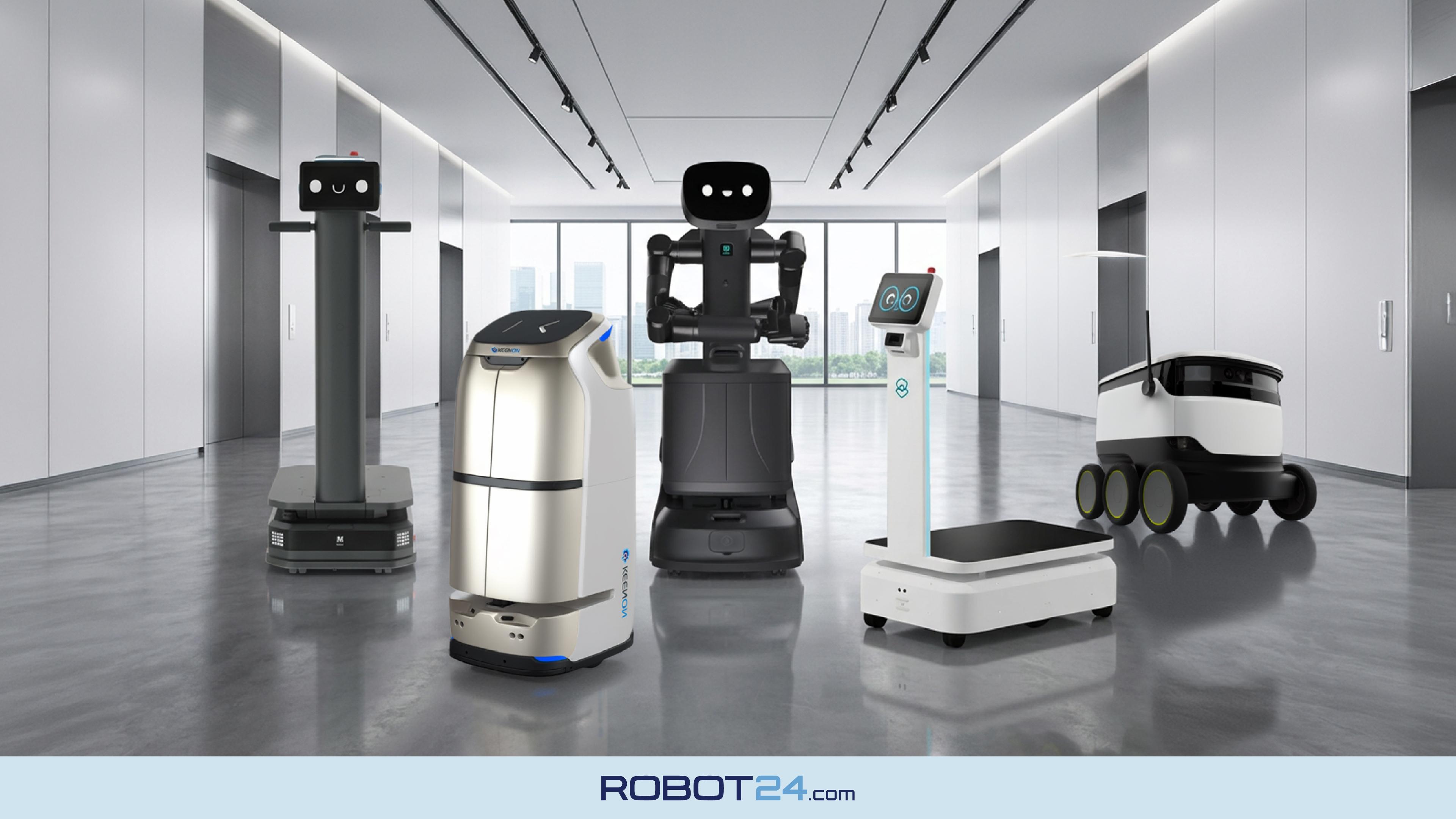
The following ranking includes Starship's Delivery Robot, PUDU's FlashBot Arm and T150, KEENON's BUTLERBOT W3 and United Robotics Group's uLog Deliver 300.
Each model is assessed according to ROBOT24.com's Market Research Database criteria in five categories: task execution; autonomy and reliability; mobility and environment; operational endurance; and deployment and integration. The ranking is based on technical specifications and deployment evidence of models. The methodology is provided below.
At a Glance
| Rank | Robot | Overall score | Robot24 price | Standout specification | Best suited to |
|---|---|---|---|---|---|
| 1 | KEENON BUTLERBOT W3 | 86/100 | US$20,000–30,000 | Calls and rides lifts on its own; up to 4 enclosed compartments | Multi-storey hotels, hospitals and offices |
| 2 | Starship Delivery Robot | 82/100 | US$3,000–5,000+ | Level 4 autonomy, 18 h per charge, climbs kerbs | Sidewalk deliveries on campuses and in neighbourhoods |
| 3 | PUDU FlashBot Arm | 81/100 | ~US$30,000–50,000 | Dual 7-DOF arms press lift buttons and open doors | Buildings without lift or door integration |
| 4 | United Robotics Group uLog Deliver 300 | 79/100 | US$25,110 or from US$659/month | 300 kg payload, indoor and outdoor operation | Heavy goods across factories and industrial parks |
| 5 | PUDU T150 | 77/100 | ~US$9,630 | 12 h runtime, 90% charge in 2 h | Parts and supplies in factories and warehouses |
This comparison is based on ROBOT24.com Market Research Database records.
The Robots Behind the Rankings
1. KEENON BUTLERBOT W3: The most complete indoor courier
Overall score: 86/100
BUTLERBOT W3 ranks first for being able to make deliveries within buildings completely autonomously. A combination of enclosed compartments and an autonomous lift travel makes this robot particularly suitable for multi-storeyed hotels, hospitals, and offices.
The biggest advantage of the W3 is its integration with the IoT elevator: the robot calls the elevator, travels in it and exits by itself. This allows building operators not to leave their places while receiving meals, medicines, documents and parcels on the required floor. The robot has two to four enclosed compartments, each capable of holding up to 90L and 20kg. Automatic doors ensure privacy and hygiene of transported things.
LiDAR SLAM, dual stereo vision, and fleet management enable multibot operations, and the robot is operational up to 12 hours, or even 15 hours in certain conditions. But it needs to be charged for 6.5 hours, and its maximum speed of 0.8 m/s and threshold of 15 mm are suitable for smooth indoor floors only.
2. Starship Delivery Robot: The sidewalk specialist
Overall score: 82/100
When it comes to outdoor deliveries, Starship has something to say. The robot ranks second due to the greatest runtime and proven autonomy in outdoor conditions among other robots. Despite the absence of detailed cargo and supporting information, Starship is inferior to the leader.
Level 4 autonomy enables the robot to complete more than 99% of journeys independently, and remote assistance is available in rare situations. Twelve cameras, radar, ultrasonic, and time-of-flight sensors enable detecting pedestrians, cyclists, cars, and traffic lights, and six-wheel bogie suspension allows it to climb kerbs. The robot can work for about 18 hours on one charge, and it is designed to function in rain, snow, and heat conditions.
Cargo capacity is the key: the robot can transport up to three shopping bags in an insulated and locked compartment, and there are no published data on its payload. The price of $3,000-5,000+ is based on the unit costs, as Starship uses robots mainly as a delivery service.
3. PUDU FlashBot Arm: The robot that opens its own doors
Overall score: 81/100
The FlashBot Arm robot is remarkable for its arms. The robot possesses two 7-DOF arms with dexterous hands and is capable of pressing buttons in the elevator, opening doors and swiping access cards.
VSLAM and LiDAR SLAM, panoramic and RGBD cameras and LLM-based task planning support autonomous delivery, and it hands items over directly. Its cargo compartment carries 15 kg, and it recharges autonomously.
It ranks third because of its endurance: eight hours unloaded with a four-hour recharge. ROBOT24.com records no travel speed, warranty or lead time, and at ~US$30,000–50,000 it is the most expensive robot here.
4. United Robotics Group uLog Deliver 300: The heavy hauler
Overall rating: 79/100
In this ranking, the highest payload offered by a robot is 300 kg with uLog Deliver 300. This robot has an advantage of flexibility: free, track, mixed and follow navigation types; operation in both indoor and qualified outdoor industrial environments; IP43 enclosure from –10°C to +65°C.
Obstacle avoidance system features 360° LiDAR and a depth camera with ±5 mm positioning accuracy. Integration includes no-code mission planning; REST APIs and an SDK; compatibility with WMS, MES and RCS; optional lift integration; automatic door passing.
The fourth-place rating of this robot is due to a 10-hour run time with 5.5 hours charging (wireless charging is automatic). It costs US$25,110 or rents from US$659 per month; the warranty conditions have not been confirmed by the records.
5. PUDU T150: The factory runner
Overall rating: 77/100
This robot closes the ranking and moves the components and supplies between workstations, storage and production lines. It can carry 150 kg, while its lifting version can lift cargo with 60 mm lift stroke.
Navigation with VSLAM and LiDAR SLAM supported with 360° dual LiDAR, RGBD cameras and human detection allows safe moving through 600 mm aisles. Unloaded operation time is 12 hours; robot charges to 90% within two hours. It has a lift integration, passes through e-gates, integrates with IoT and APIs.
Fifth-place rating is justified by the fact that robot is designed to operate indoors in factory or warehouse, working within 0–40°C temperature; there is no warranty information in the ROBOT24.com market records data. Cost of this robot (~US$9,630) makes it the most affordable one in this ranking.
The Best Fit Depends on the Route
The KEENON BUTLERBOT W3 wins in this comparison by its ability to move autonomously with lift; safe compartments; and long operation time. Sidewalk and campus deliveries are better suited for Starship Delivery Robot. Lack of lifts and door integration in a building may highlight the PUDU FlashBot Arm's ability to press buttons and open doors independently. Heavier load in a factory or industrial park requires uLog Deliver 300; the cheapest robot for indoors is PUDU T150.
Which one to choose ultimately depends on the route type; what is being delivered and how robot will get through the gates, lifts, and doors.
More articles on this topic
74 articles ReportThe Best Robots for Office Buildings 2026
 ReportBest Robots for Airports 2026
 ReportThe Best Robots for Shopping Malls 2026ReportBest Robots for Retail Stores 2026
 ReportThe Best Educational Robots for Schools and Universities 2026
 ReportThe Best robots for Hospitals and Healthcare 2026
 ReportThe Best Warehouse Robots and AMRs 2026
 ReportThe Best Commercial Cleaning Robots 2026
 ReportThe Best Restaurant Service Robots 2026
 ReportThe Best Service Robots for Hotels 2026
 ReportThe Best Security Patrol Robots 2026
 ReportThe Best Robot Dogs for Security and Inspection 2026
BUSINESS NEWS WEEKLY LETTER
The Weekly Letter for Robotics Professionals, Summarizing the Most Important Industry Moves, Launches, Deals and Signals.