Leopard Imaging, Lumotive Introduce Long-Range 3D Sensor for Robots
The Sirius Max platform combines RGB imaging with indirect time-of-flight depth sensing and programmable beam steering. The companies have not disclosed pricing, availability or customer deployments.

September 25, 2026 by Artem
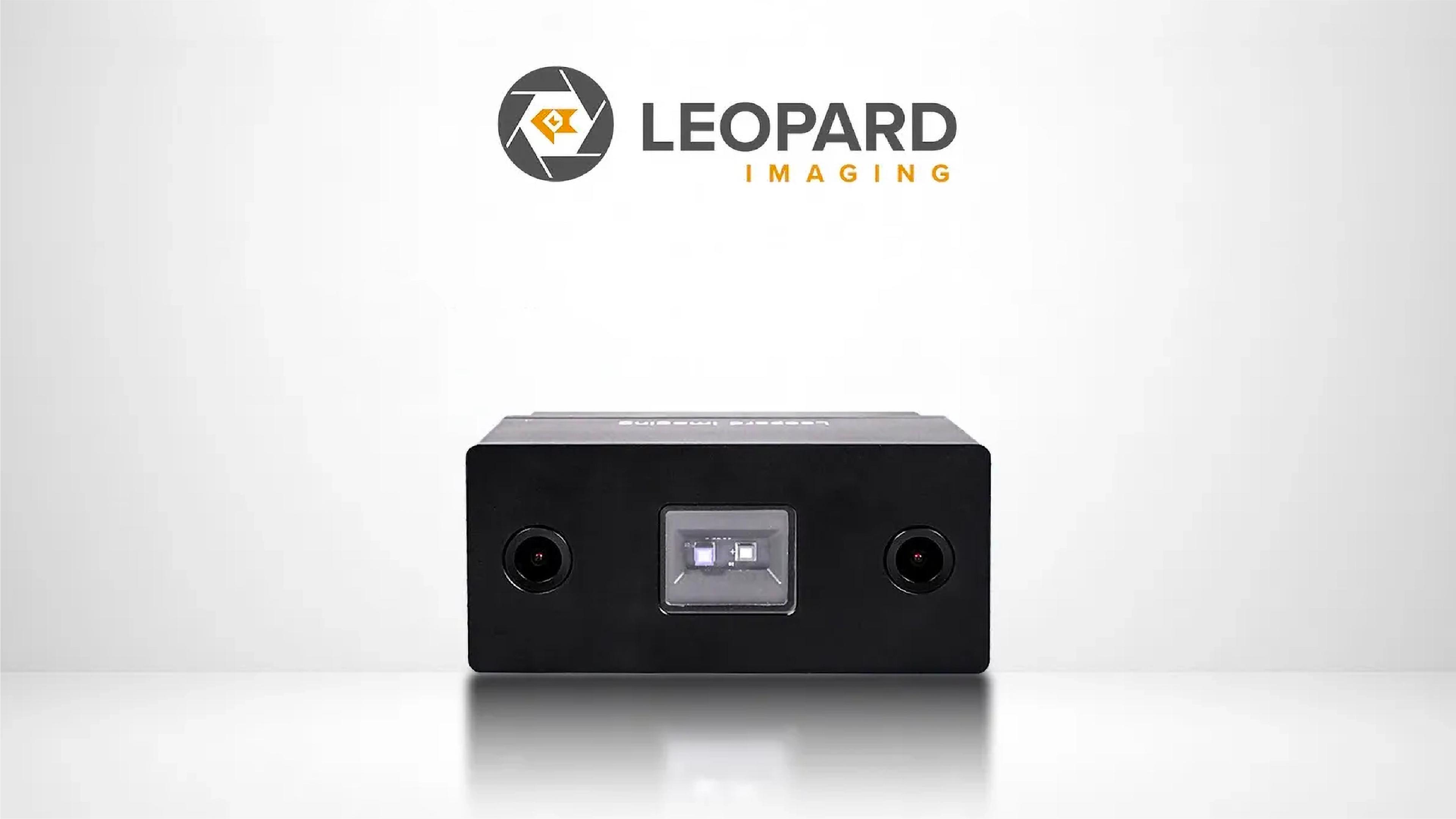
FREMONT, Calif. — Leopard Imaging and Lumotive introduced Sirius Max, a solid-state 3D perception platform that provides robots with color imaging and depth sensing via a single sensing module.
The companies announced Sirius Max on Sept. 24, saying the system combines an RGB camera with indirect time-of-flight, or iToF, depth sensing and programmable beam steering. California-based Leopard Imaging and Washington-based Lumotive did not disclose pricing, an availability date or any customers using the platform.
Sirius Max uses Lumotive's TX10 light emitter to steer light electronically rather than through moving mechanical components. The companies say software enables the sensor to focus illumination and depth scanning on selected areas rather than illuminating the entire field uniformly.
Lumotive's technical documentation separately describes the TX10 as a software-controlled solid-state transmitter that manages beam direction, divergence, dwell time and scan patterns. The reference design offers a 105° steering range.
The platform also incorporates onsemi's AF0130 depth sensor. Onsemi identifies the component as a 1.2-megapixel iToF sensor with on-chip processing that generates depth, confidence and intensity data.
Indirect time-of-flight systems determine distance by transmitting modulated infrared light and detecting the phase offset of the reflected signal. For robots, depth data can support tasks including navigation, obstacle detection and manipulation by helping software estimate the position and shape of objects.
Leopard Imaging and Lumotive claim that Sirius Max can provide depth sensing at a range of more than 20 meters, indoors and outdoors, with a 1‑megapixel depth resolution. Applications include simultaneous localization and mapping, collision avoidance, visual inspection, object handling and navigation.
The module sends synchronized RGB images, depth information and control signals through a GMSL2 connection over a single coaxial cable, according to the announcement. Those range and performance claims have not been independently tested.
Neither company provided benchmark results comparing Sirius Max with competing depth cameras or LiDAR systems. They also have not said when customers will be able to order the platform or whether units have been delivered.
More articles on this topic
60 articles ReportBoston Dynamics Sacrifices Atlas’ Fifth Finger for Efficiency
 ReportAgility Adds FORT Safety Infrastructure to Digit 5
 ReportEni, Generative Bionics Partner on Industrial Humanoid Robotics
 ReportFeather Prices Modular Dual-Arm Robot at $29,990
 ReportSamsung Plans Factory-First Path for Humanoids Before Home Robots
 ReportNvidia Develops Safety Controls as AI Advances Into Robotics
 ReportDyna Launches Wheeled Semi-Humanoid for Full Workflows
 ReportRobotera Says Dexterous Hands, Not Walking, Are Humanoids’ Bigger Challenge
 ReportFlourish Opens Preorders for $3,555 Trainable Home Robot
 ReportSiMa.ai Raises $150 Million to Scale Chips for Humanoids, Physical AI
 ReportNauticus Robotics Seeks Up to $50M in Strategic Investment
 ReportHitachi, Agile Robots Partner to Bring Physical AI Into Factories
BUSINESS NEWS WEEKLY LETTER
The Weekly Letter for Robotics Professionals, Summarizing the Most Important Industry Moves, Launches, Deals and Signals.