PUDU KettyBot Pro vs. KEENON DINERBOT T9 Pro
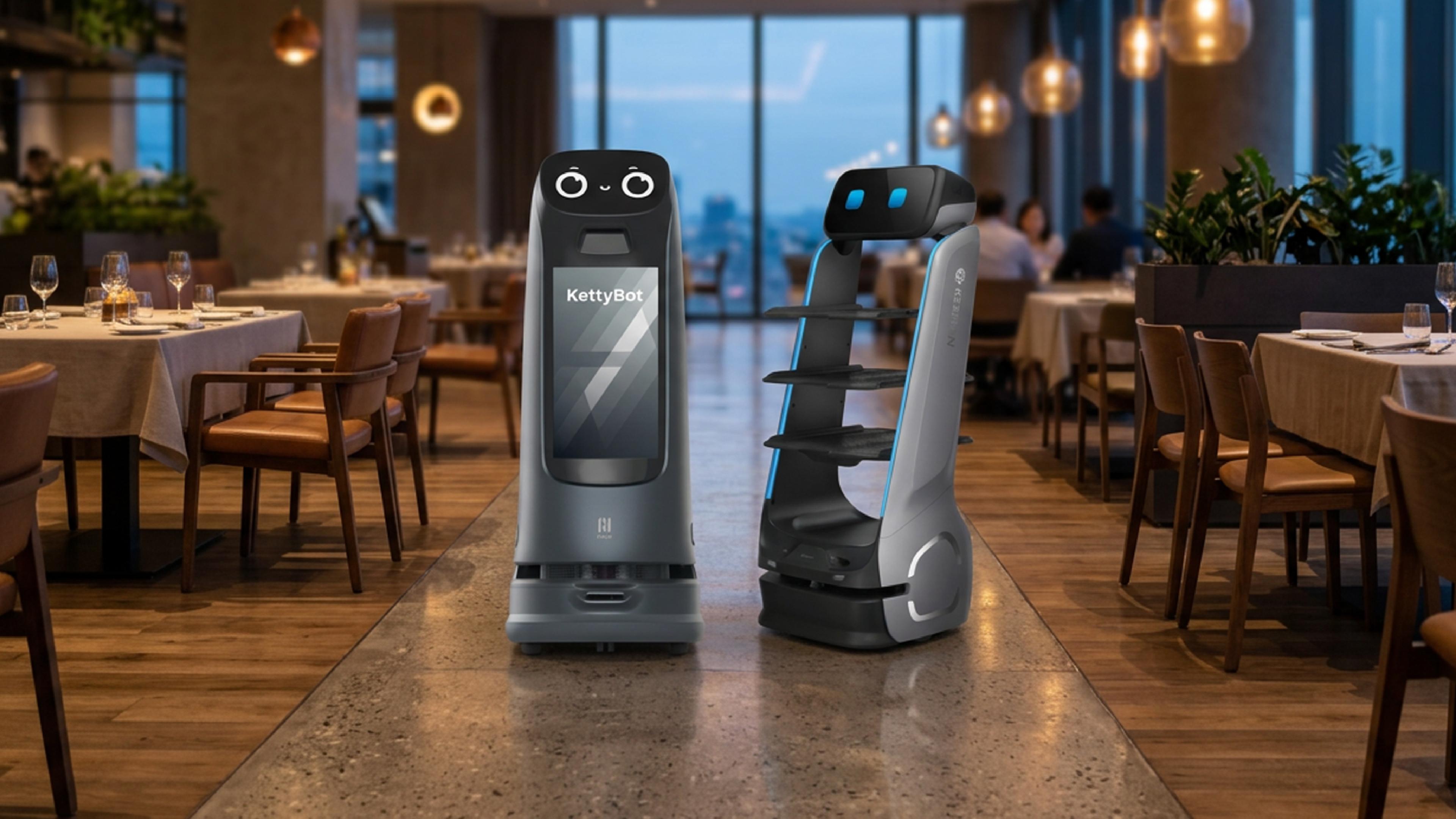
PUDU KettyBot Pro and KEENON DINERBOT T9 Pro are commercial service robots designed for customer-facing environments. While KettyBot Pro combines delivery and promotional applications, DINERBOT T9 Pro focuses on service workflows requiring extended operating endurance. We compare their physical dimensions, navigation, passage requirements, charging time, fleet coordination and commercial applications.

November 17, 2026 by Business Desk Team
Introduction
Restaurants, hotels and other customer-facing businesses increasingly use service robots to support repetitive tasks, including transporting items and interacting with visitors. These robots can assist staff by moving through designated indoor routes, carrying suitable items and supporting service operations.
However, commercial service robots differ in their physical dimensions, operating endurance, navigation requirements and intended applications. Some are designed to combine delivery functions with promotional displays and customer engagement.
Others emphasize extended operation and coordination across busy service environments. PUDU KettyBot Pro and KEENON DINERBOT T9 Pro represent two approaches to commercial service robotics.
PUDU KettyBot Pro is a Chinese service robot positioned for food service, hospitality, entertainment and commercial experiences. KEENON DINERBOT T9 Pro is another Chinese service robot associated with hospitality, retail and showroom operations, and healthcare.
Both robots support LiDAR navigation, Wi-Fi connectivity, software updates and multi-robot coordination. However, their recorded specifications reveal differences in height, weight, operating speed, minimum passage width and battery endurance.
KettyBot Pro is shorter and lighter, with a narrower stated passage requirement. DINERBOT T9 Pro has a longer recorded maximum runtime and explicitly supports coordination of up to 20 robots.
Based on ROBOT24.com market-research data records, this comparison examines their mobility, service capabilities, operating requirements and suitability for different commercial environments.
At a Glance
| Height | 112 (PUDU Academy specification) cm | 1,266 mm |
|---|---|---|
| Weight | 38 (PUDU Academy specification) kg | 45.2 kg |
| Availability | Commercially launched by PUDU and currently listed in its service-robot range; regional dealer stock and shipping require confirmation. | Commercially Available |
| Charging Time | ~4 h | Approximately 4 hours |
| LiDAR | Yes | Yes |
| Maximum Speed | 1.2 m/s | 0.8 m/s |
| Minimum Passage Width | ~60 cm | 70 cm |
| Multi-Robot Coordination | Supported | Yes (up to 20 robots) |
| Nationality | Chinese | Chinese |
| OTA Updates | Yes | Supported |
| Runtime | Up to 8 h | Up to 15 hours |
| Wi-Fi | Yes | Yes |
| Typical use | Food Service, Hospitality, Entertainment & Commercial Experiences | Hospitality, Retail & Showroom Operations, Healthcare |
| Status | Commercial | Commercial |
How They Compare
Product positioning and intended applications
PUDU KettyBot Pro and KEENON DINERBOT T9 Pro are both designed for commercial service environments, but their recorded applications differ. KettyBot Pro combines service delivery with customer-facing promotional functions.
This makes it relevant to restaurants, hospitality venues and businesses that want a robot to support both operational tasks and customer engagement. DINERBOT T9 Pro is positioned for hospitality, retail and showroom operations, and healthcare.
Its recorded specifications emphasize service-related mobility, operating endurance and multi-robot coordination. Both robots may be relevant to businesses seeking to automate selected transport and service tasks. However, their suitability depends on the items being transported, the layout of the facility and the required operating schedule.
Height and physical design
PUDU KettyBot Pro has a recorded height of 112 cm. KEENON DINERBOT T9 Pro measures 1,266 mm, equivalent to 126.6 cm. DINERBOT T9 Pro is therefore 14.6 cm taller. This difference may influence how the robots fit into their operating environments.
A shorter robot may be easier to accommodate in spaces with certain physical restrictions. A taller robot may position its service interface differently relative to customers and staff. However, height alone does not establish ease of access or usability.
The supplied records do not provide directly comparable tray heights, display positions or overall footprints. These measurements would be useful when evaluating customer interactions and item handoffs.
Weight and handling
KettyBot Pro weighs 38 kg according to the supplied PUDU Academy specification. DINERBOT T9 Pro weighs 45.2 kg. Based on these figures, T9 Pro is 7.2 kg heavier, approximately 19% more than KettyBot Pro. This difference may affect transportation, repositioning and handling.
However, a heavier robot does not necessarily have greater carrying capacity. Payload limits depend on structural design, motor performance and load distribution. The supplied records do not provide comparable payload capacities for the two robots. Consequently, weight should not be used to determine which platform can transport heavier orders.
Navigation and LiDAR
Both KettyBot Pro and DINERBOT T9 Pro have LiDAR listed in their specifications. LiDAR uses laser-based distance measurements to help robots perceive their surroundings. In commercial service environments, this information can support localization, route planning and obstacle detection.
However, the presence of LiDAR does not establish identical navigation performance. Sensor placement, navigation software and obstacle-avoidance systems can differ. Restaurants and hospitality venues often contain moving people, chairs, tables and temporary obstacles. A direct navigation comparison would require evaluating both robots along the same routes under comparable conditions.
Minimum passage width
Minimum passage width is one of the most relevant differences between the two platforms. KettyBot Pro has a recorded minimum passage requirement of approximately 60 cm. DINERBOT T9 Pro requires 70 cm. Based on these figures, KettyBot Pro can operate through passages approximately 10 cm narrower.
This may be important in restaurants where tables, chairs and service equipment restrict movement. For example, a venue with a 65 cm passage may meet KettyBot Pro's stated minimum requirement but fall below the recorded minimum for T9 Pro. However, the published minimum should not automatically be treated as the recommended operating clearance. Actual navigation may require additional space for turning, obstacle avoidance and safe movement around people. Businesses should assess their narrowest routes and test the robots in the intended environment.
Maximum movement speed
KettyBot Pro has a recorded maximum speed of 1.2 m/s. DINERBOT T9 Pro has a recorded maximum speed of 0.8 m/s. Converted to kilometers per hour, these figures are approximately 4.32 km/h and 2.88 km/h, respectively.
KettyBot Pro therefore has a stated maximum movement speed that is 50% higher. However, maximum speed does not establish faster service completion. A robot may travel below its maximum speed when carrying items, navigating crowded spaces or approaching customers. Route length, obstacle avoidance and handoff procedures also influence delivery time. A meaningful comparison would require both robots to complete the same loaded service route.
Food-service applications
Food service is among KettyBot Pro's recorded applications. In restaurants, service robots may assist with transporting prepared orders or other suitable items between designated locations. KettyBot Pro's narrow passage requirement may be relevant to dining rooms with restricted aisle space.
DINERBOT T9 Pro is also a commercial service robot associated with hospitality operations. Its suitability for restaurant workflows would depend on its carrying configuration, navigation and service interface. However, the supplied records do not provide comparable tray capacities, maximum payloads or number of supported delivery destinations. These specifications are necessary before determining which robot is better suited to transporting meals or drinks.
Hospitality operations
Hospitality is a shared application category for both robots. Hotels, restaurants and other hospitality venues may use mobile service robots to support selected customer-facing activities.
KettyBot Pro's recorded applications include entertainment and commercial experiences alongside food service. DINERBOT T9 Pro is associated with hospitality and other service environments. For hospitality operators, relevant considerations include how the robot interacts with guests, how it moves through shared spaces and how easily staff can manage its tasks.
The supplied records do not establish identical customer-interaction or service-management functions. Businesses should evaluate the exact workflows supported by each platform.
Promotional and customer-engagement functions
KettyBot Pro is positioned for commercial experiences and customer-facing promotional applications. Its role can extend beyond transporting items to supporting suitable marketing and engagement activities.
For businesses seeking a robot that combines service delivery with promotional functions, this positioning may be relevant. DINERBOT T9 Pro is associated with retail and showroom operations. However, the supplied records do not specify the exact promotional capabilities or display features of T9 Pro.
It would therefore be inappropriate to assume that both robots provide equivalent advertising or customer-engagement functions. A direct comparison would require details about their displays, supported content formats and interactive features.
Retail and showroom operations
Retail and showroom operations are included among DINERBOT T9 Pro's recorded applications. In these environments, service robots may support customer-facing workflows or transport suitable items within designated areas.
KettyBot Pro's commercial-experience positioning may also be relevant to retail settings. However, the robots may be configured for different types of interaction. The supplied records do not identify their exact retail workflows, supported software integrations or customer-interaction features.
Businesses should confirm whether the intended application involves delivery, promotion, information assistance or a combination of these functions.
Healthcare applications
Healthcare is included among DINERBOT T9 Pro's recorded applications. Mobile service robots may be considered for suitable nonclinical transport and support tasks in healthcare facilities.
However, healthcare environments can involve additional requirements concerning hygiene, privacy and operational safety. The supplied records do not establish that T9 Pro is certified as a medical device or suitable for clinical procedures.
KettyBot Pro does not have healthcare explicitly included among its listed typical uses. This does not necessarily exclude all healthcare-related applications, but suitability would require separate verification.
Battery runtime
Operating endurance is one of the clearest differences between the two robots. KettyBot Pro has a recorded runtime of up to eight hours. DINERBOT T9 Pro has a recorded runtime of up to 15 hours. Based on these figures, T9 Pro offers seven additional hours of stated maximum operation.
Its maximum recorded runtime is approximately 88% longer than KettyBot Pro's. This may be relevant to restaurants, hotels and other venues with extended operating hours. However, the figures do not establish that both robots were tested under equivalent conditions.
Battery endurance can depend on movement, payload, display usage, network activity and periods of inactivity. A direct comparison would require runtime measurements under the same service workload.
Charging time
Both robots have a recorded charging time of approximately four hours. This means neither platform has a stated charging-time advantage based on the supplied specifications. However, their different runtimes may influence charging schedules.
A robot with longer operating endurance may require fewer charging interruptions during an extended shift. For example, a venue operating for more than eight hours may need to schedule KettyBot Pro's charging around its workload.
T9 Pro's stated maximum runtime may provide greater scheduling flexibility if achieved under the relevant operating conditions. Actual charging arrangements should be confirmed for the exact configuration being purchased.
Multi-robot coordination
Both robots support multi-robot coordination. KettyBot Pro has coordination support listed, although the supplied records do not specify the maximum number of robots that can operate together.
DINERBOT T9 Pro supports coordination of up to 20 robots. This may be relevant to larger facilities using multiple robots across shared routes. Coordinated operation can help manage traffic and reduce conflicts between compatible robots.
However, the number of supported robots does not establish actual fleet performance. Network conditions, route design, software configuration and operating density can influence coordination. The supplied records do not establish how many KettyBot Pro units can be coordinated in an equivalent environment. A fair comparison would require confirmation of its supported fleet size and operating conditions.
Wi-Fi connectivity
Both KettyBot Pro and DINERBOT T9 Pro support Wi-Fi. Wireless connectivity can support compatible communication, configuration and management functions. In commercial environments, network reliability may influence the operation of connected robot fleets.
However, Wi-Fi support alone does not establish identical cloud services or fleet-management capabilities. The supplied records do not specify the supported wireless standards or network requirements for either robot. Businesses should confirm compatibility with their existing network infrastructure.
Over-the-air software updates
Both robots support OTA software updates according to the supplied records. Over-the-air updates allow compatible software changes to be delivered without requiring every update to be installed through a physical connection. This can simplify maintenance for businesses operating multiple robots.
However, OTA support does not establish identical software-update schedules or long-term support commitments. Organizations should confirm the update procedures, service terms and supported software versions for each platform.
Commercial availability
Both KettyBot Pro and DINERBOT T9 Pro have commercial status. KettyBot Pro has been commercially launched by PUDU and remains listed in its service-robot range.
However, regional dealer stock and shipping arrangements require confirmation. DINERBOT T9 Pro is listed as commercially available.
Availability may still vary by market, configuration and distributor. Businesses should confirm purchasing arrangements, warranty coverage, spare-parts availability and technical support before deployment.
Maintenance and operational requirements
Commercial service robots require routine maintenance to support reliable operation. Maintenance may include cleaning sensors, checking wheels, inspecting carrying surfaces and monitoring battery condition. For restaurants, food-contact procedures and cleaning requirements may also be relevant.
KettyBot Pro and DINERBOT T9 Pro may have different maintenance procedures depending on their hardware configurations. The supplied records do not include directly comparable service intervals, consumable costs or maintenance requirements. These factors should be considered alongside purchasing costs and operating endurance.
Summary
PUDU KettyBot Pro and KEENON DINERBOT T9 Pro are commercial service robots designed for customer-facing environments. KettyBot Pro is positioned for food service, hospitality, entertainment and commercial experiences.
It measures 112 cm tall, weighs 38 kg and has a recorded minimum passage requirement of approximately 60 cm. Its stated maximum speed is 1.2 m/s, and its recorded runtime is up to eight hours.
DINERBOT T9 Pro is associated with hospitality, retail and showroom operations, and healthcare. It measures 126.6 cm tall, weighs 45.2 kg and requires a minimum passage width of 70 cm. Its recorded runtime is up to 15 hours, and it supports coordination of up to 20 robots.
Based on the supplied specifications, KettyBot Pro has the narrower stated passage requirement, lower weight and higher maximum movement speed. DINERBOT T9 Pro has longer stated maximum operating endurance and a documented multi-robot coordination limit.
Both robots have similar recorded charging times and support LiDAR, Wi-Fi and OTA software updates. However, these differences do not establish an overall performance winner. KettyBot Pro may be relevant to businesses prioritizing compact movement and a combination of service and promotional applications.
DINERBOT T9 Pro may be relevant to businesses prioritizing longer operating endurance and coordinated service across multiple robots. The appropriate choice depends on the operating environment, route layout, service workload, carrying requirements and available technical support.
This comparison is based on ROBOT24.com market-research data records rather than controlled performance testing. Runtime, navigation performance, fleet coordination and commercial availability should be verified against current manufacturer documentation before drawing conclusions about overall performance.
More articles on this topic
163 articles ReportRichtech DUST-E S vs. Gausium Phantas
 ReportEngineAI SE01 vs. AGIBOT RAISE A1ReportRichtech DUST-E S vs. KEENON KLEENBOT C20
 ReportAGIBOT X2 vs. Unitree R1
 ReportPUDU CC1 vs. UniRing MAX
 ReportPUDU KettyBot vs. KEENON DINERBOT T8
 ReportPUDU CC1 vs. KEENON KLEENBOT C55 vs. UniRing MAX
 ReportCleanfix S170 Navi vs. SoftBank Robotics Whiz vs. KEENON KLEENBOT C30
 Report1X Technologies NEO Gamma vs. AGIBOT A2 Max
 ReportAI² Robotics AlphaBot 2 vs. AGIBOT A2-W
 ReportAGIBOT D1 Pro vs. Unitree Go2 Edu Plus
 ReportAGIBOT G2 vs. Astribot S1
BUSINESS NEWS WEEKLY LETTER
The Weekly Letter for Robotics Professionals, Summarizing the Most Important Industry Moves, Launches, Deals and Signals.