X Square Robot Releases WALL-OSS-1.0 Vision-Language-Action Model
X Square Robot says its WALL-OSS-1.0 model succeeded on 55.1 percent of 312 unfamiliar real-robot tasks with no fine-tuning, while XR Harness coordinates longer jobs.

November 24, 2026 by Dr Maulik Vyas
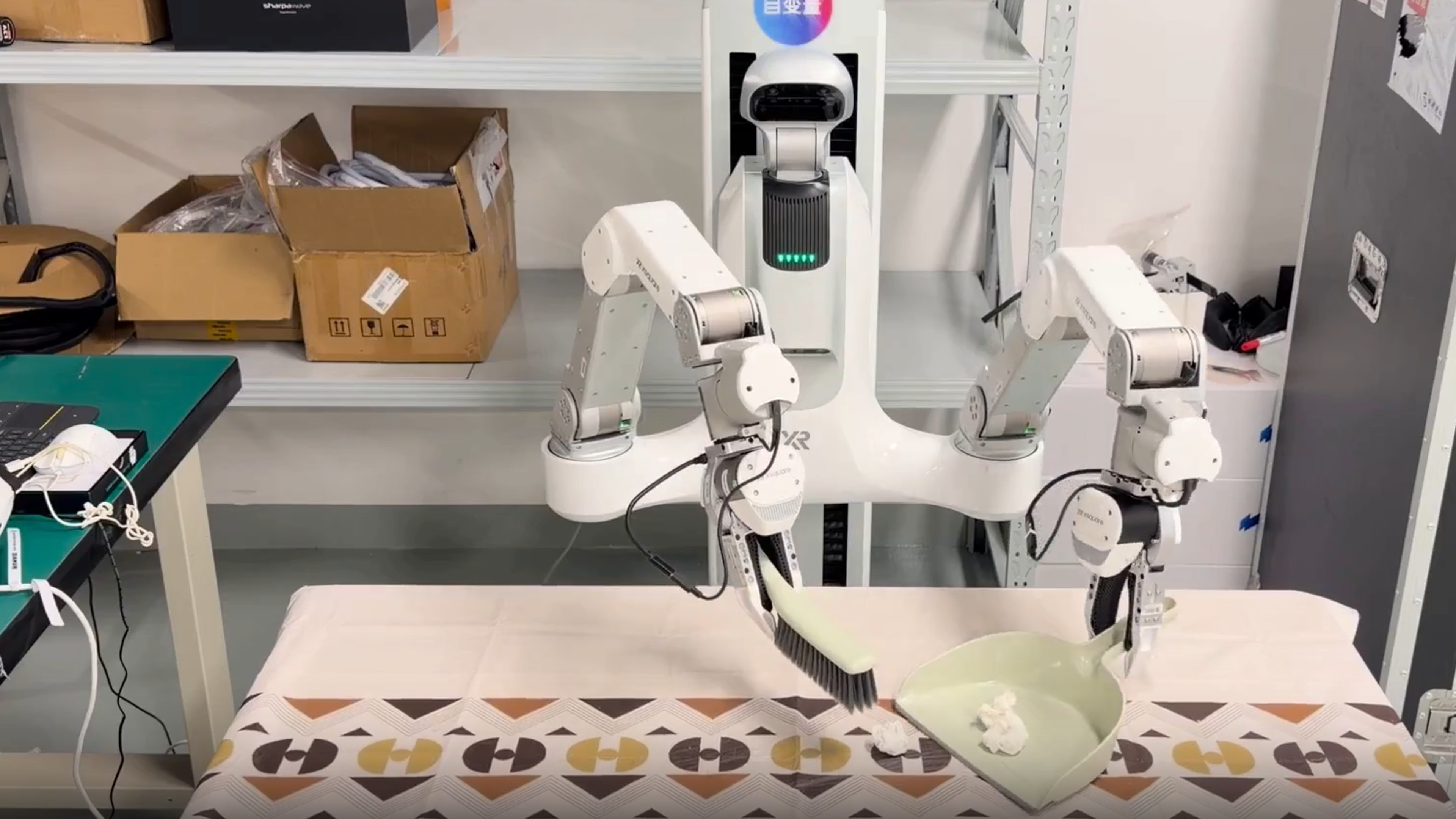
X Square Robot announced on Nov. 23 that it has unveiled WALL-OSS-1.0, a vision-language-action foundation model, together with XR Harness, an agent framework for complex task execution, and WALL-API-1.0, an interface for developers and enterprises. The Shenzhen-based company stated that the model reached a 55.1 percent zero-shot success rate across 312 real-robot tasks that evaluators selected freely, without task-specific demonstrations or fine-tuning, and that the tasks covered unfamiliar objects, tool use, bimanual coordination and multi-step manipulation.
X Square Robot stated that WALL-OSS-1.0 uses native pretraining, in which vision, language and robot actions shape the model together from the start, instead of adding robotic actions to a finished vision-language model. The model starts from a Qwen3.5 base and combines language, vision-language and robot-action data in one training process, while an action tokenizer converts continuous robot movements into discrete tokens and a flow-matching Action Expert turns visual and language context into continuous commands.
On ManipArena, a real-world benchmark of 15 tabletop tasks, the company stated that WALL-OSS-1.0 scored 1,101 out of 1,500 points directly after pretraining, which it says is 52.5 percent higher than its predecessor WALL-OSS-0.5 and 70.8 percent higher than a multi-task fine-tuned π0.5 baseline. It added that a policy trained without WALL-OSS-1.0 pretraining saw its success rate drop by more than 90 percent across sites.
XR Harness is meant to extend the model to longer jobs through three connected systems, which are a planning layer that revises steps using observations and feedback, an execution layer in which WALL-OSS-1.0 carries out individual steps and a layer that connects to robot controllers and sensors. The company stated that its long-term goal is for robots to enter unfamiliar environments, understand new instructions and act effectively without task-specific demonstrations or fine-tuning for every task, and that the code and model weights will be open-sourced soon.
The results show progress toward that goal and also its distance. A 55.1 percent zero-shot success rate means that close to half of the attempted tasks were not completed, and the announcement does not break the figure down by task type or state how many attempts were made for each task. The benchmark scores come from X Square Robot and its chosen evaluations, so independent testing, together with the release of the code and weights, will show whether pretrained models and coordination harnesses generalize to unfamiliar tasks in other labs and factories.
More articles on this topic
283 articles ReportWhat it Really Costs to Own a Personal Assistant Robot at Home
 ReportTürkiye Launches State Grant Program Covering 50% of Industrial Humanoid Robot Development Budgets
 ReportAGIBOT Deploys Dozens of G2 Robots on Lens Technology's Smartphone Testing Lines
 ReportInlif Secures More Than $10 Million in Agreements for Its New Six-Axis Industrial Robots
 ReportSingapore's Botsync Raises $11 Million to Expand Its Factory Robotics Platform
 ReportHumyn Labs Raises $47 Million to Build Real-World Training Data for Robotics
 ReportBoston Dynamics Selects GlobalFoundries as First Semiconductor Customer for Atlas Humanoid Trials
 ReportGenesis AI Raises $500 Million at a $3.5 Billion Valuation to Scale General-Purpose Robots
 ReportMultiway Robotics Showcases Intralogistics Solutions and Wheeled Humanoid at CeMAT ASIA
 ReportFORT Robotics Files Registration Statement for Public Listing Partnership
 ReportRobot Baristas are Learning to Reproduce the Art of Professional Coffee Making
 ReportTARSBOT and Aptiv Plan to Deploy 100 Industrial Robots Across 33 Factory Applications
BUSINESS NEWS WEEKLY LETTER
The Weekly Letter for Robotics Professionals, Summarizing the Most Important Industry Moves, Launches, Deals and Signals.