Genesis AI Raises $500 Million at a $3.5 Billion Valuation to Scale General-Purpose Robots
Genesis AI is pairing a human-proportioned robot hand with data-collection gloves, simulation and its own foundation model to scale its Eno robot.

November 18, 2026 by Dr Maulik Vyas
Genesis AI announced on Nov. 17 that it has raised $500 million in Series A funding at a post-money valuation of $3.5 billion, with the round co-led by Premji Invest, Khosla Ventures and Eclipse and joined by investors including NVIDIA, AMD Ventures and former Google CEO Eric Schmidt. The company, which operates in Paris and San Carlos, California, was founded in 2024 by Zhou Xian and Théophile Gervet, who met as graduate students at Carnegie Mellon University.
The funding is intended for data acquisition and large-scale training, work on human-level manipulation, the deployment of its general-purpose robot Eno with customers and the hiring of researchers and engineers. The company says Eno will first be introduced in manufacturing, logistics and laboratories, followed by hospitality and healthcare and later consumer applications.
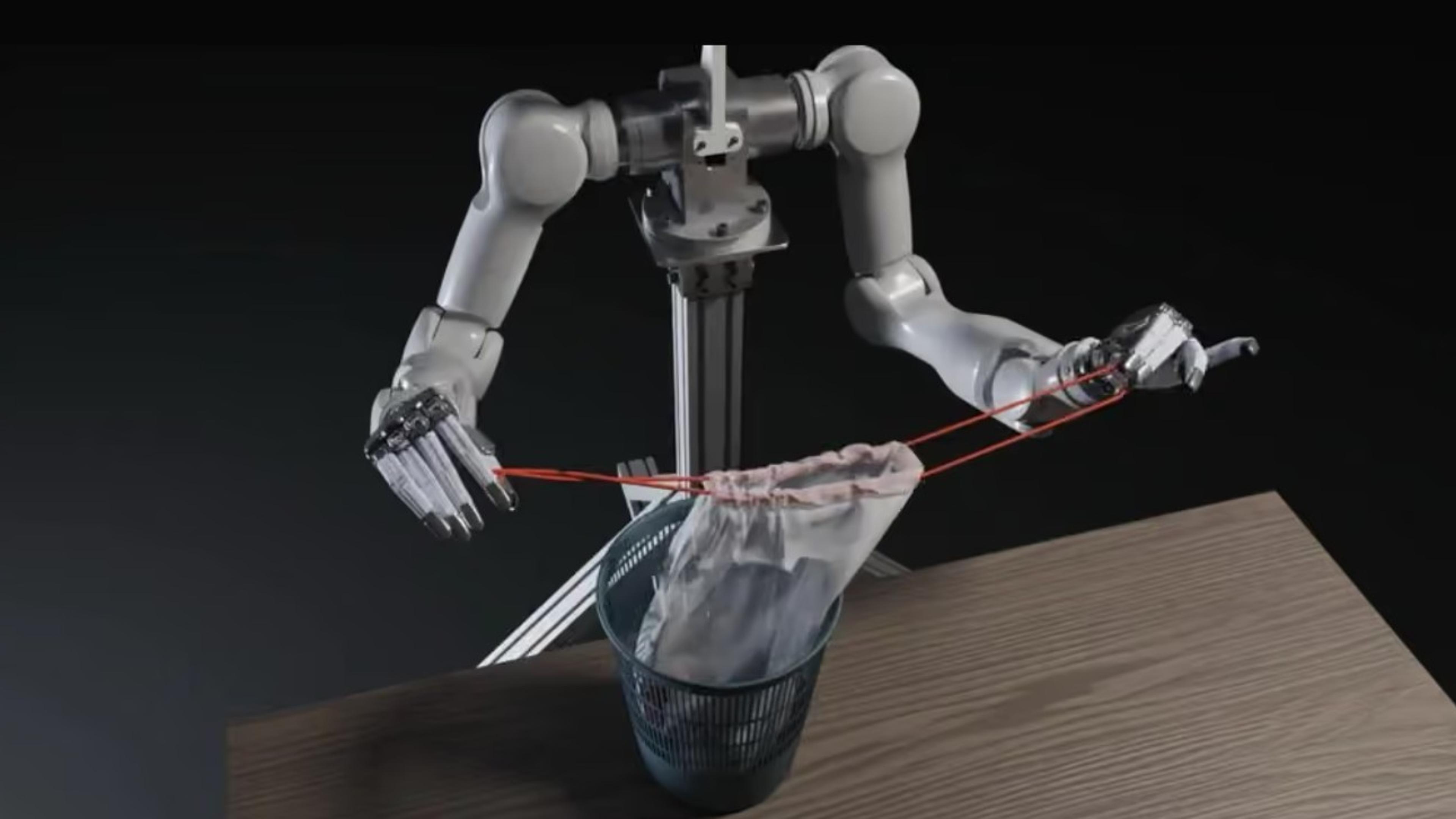
Genesis is building the robot as a single integrated system that combines GENE, its foundation model, a dexterous robotic hand, a sensor-equipped data collection glove and Genesis World, a simulation platform used to train and test skills before they are applied in the real world. The hand, the glove and a human hand are designed to map one to one, so that robots can learn from force and motion data collected while people wear the gloves and headset cameras during regular work, which, according to a report is done by more than 100 workers worldwide.
In a demonstration at the company’s Silicon Valley facility, a pair of off-the-shelf robotic arms running the model packed small boxes into a larger one, taped it shut and applied a label. During a second run the robot dropped a box and struggled to peel the label from its backing, which a Genesis executive described as the kind of hiccup data that can be used to improve the model. Eno itself was not demonstrated.
Genesis says it has built between 30 and 40 units of Eno, that the design of the mass-production version has been finalized and that a manufacturing contractor has been chosen to begin work in the United States next year, while a handful of undisclosed customers are piloting the robot. Xian said the main bottleneck is hardware, since the robot’s dexterous hands can currently operate for only a few weeks of regular work before they need to be replaced; however, the performance claims come from Genesis and from the demonstration it staged.
More articles on this topic
278 articles ReportWhat it Really Costs to Own a Personal Assistant Robot at Home
 ReportHumyn Labs Raises $47 Million to Build Real-World Training Data for Robotics
 ReportBoston Dynamics Selects GlobalFoundries as First Semiconductor Customer for Atlas Humanoid Trials
 ReportMultiway Robotics Showcases Intralogistics Solutions and Wheeled Humanoid at CeMAT ASIA
 ReportFORT Robotics Files Registration Statement for Public Listing Partnership
 ReportRobot Baristas are Learning to Reproduce the Art of Professional Coffee Making
 ReportTARSBOT and Aptiv Plan to Deploy 100 Industrial Robots Across 33 Factory Applications
 ReportSouth Korea Proposes $39 Million for Robot Actuators, Humanoid Batteries and AI Sensors
 ReportLoongson Completes ROS 2 Integration on Its Domestic Computing-Powered Intelligent Robot Vehicle
 ReportBoston Dynamics Puts Wheels on Atlas Humanoid to Test Reinforcement Learning and Motor Limits
 ReportAnt Group Open-Sources LingBot-Touch to Give Robots a Shared Sense of Touch
 ReportArrive AI Invests in Ottonomy with Plans for 50 Autonomous Delivery Robots
BUSINESS NEWS WEEKLY LETTER
The Weekly Letter for Robotics Professionals, Summarizing the Most Important Industry Moves, Launches, Deals and Signals.