Booster K1 vs. NOETIX N2
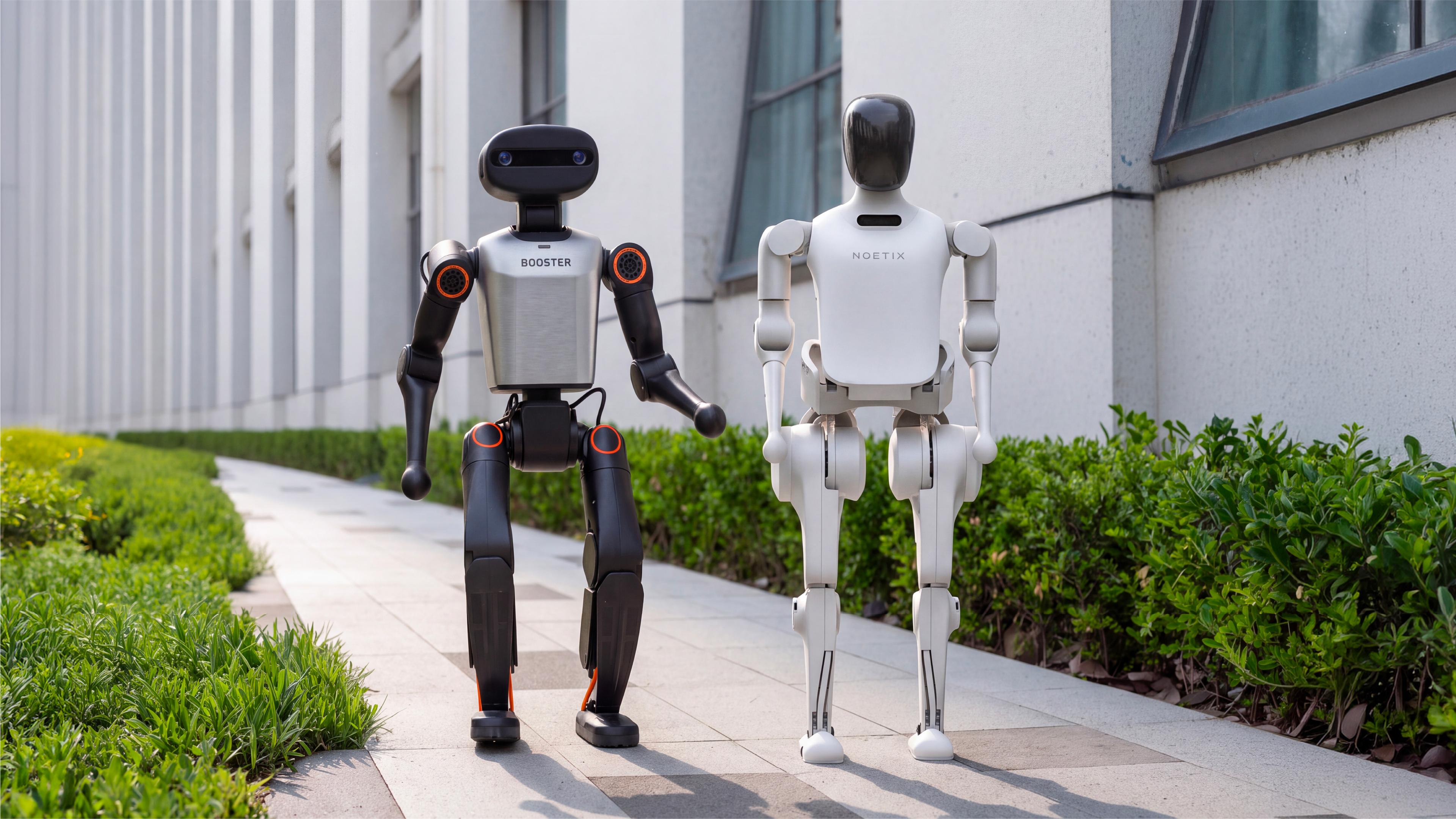
Booster K1 and NOETIX N2 are compact bipedal humanoids built for education, research and embodied AI. We compare their speed, runtime, payload, autonomy, perception and development capabilities to see how the two platforms differ.

September 29, 2026 by Business Desk Team
Introduction
At a Glance
| Metric | Booster K1 | NOETIX N2 |
|---|---|---|
| Robot type | Bipedal humanoid research robot | High-dynamic bipedal humanoid |
| Use cases | Education; research; embodied AI; reinforcement learning; locomotion; manipulation | Education; research; embodied AI; entertainment; competitions; HRI |
| Height / dimensions | ~132 cm tall | 1180 mm |
| Weight | ~35 kg | 30 kg |
| Degrees of freedom | 23-29 configuration dependent | 18 DOF |
| Payload | Approx. 3-5 kg | 5 kg |
| Maximum speed | Up to 1.5 m/s | 3.5 m/s |
| Runtime | 1-2 hours | Up to 2 hours |
| Navigation | Autonomous navigation; dynamic balance; whole-body motion planning | AI-assisted humanoid navigation; stair and multi-terrain support |
| Sensors | RGB cameras; depth camera; IMU; foot force sensors; microphones | Dual depth cameras; IMU; joint encoders |
| Special capability | ROS/ROS2 compatible; SDK; optional multi-finger hands | Up to 67 TOPS NVIDIA Jetson Orin; Python/C++ API; ROS compatibility |
| Price | USD $25,000-50,000 | USD $5,500-34,000 |
How They Compare
In terms of role, Booster K1 is recorded for Education; research; embodied AI; reinforcement learning; locomotion; manipulation, while NOETIX N2 is recorded for Education; research; embodied AI; entertainment; competitions; HRI. Their overlap is strongest where both records target the same operating environment, but the ROBOT24.com market-data entries also show different emphasis in their listed functions and deployment focus.
On the recorded performance figures, weight is listed as ~35 kg for Booster K1 and 30 kg for NOETIX N2; maximum speed is recorded as Up to 1.5 m/s versus 3.5 m/s; runtime is 1-2 hours versus Up to 2 hours.
Capacity also differs in the Robot24 records: Booster K1 lists Approx. 3-5 kg, whereas NOETIX N2 lists 5 kg.
For autonomy and perception, Booster K1 is recorded with Autonomous navigation; dynamic balance; whole-body motion planning and RGB cameras; depth camera; IMU; foot force sensors; microphones. NOETIX N2 is recorded with AI-assisted humanoid navigation; stair and multi-terrain support and Dual depth cameras; IMU; joint encoders.
Summary
Both Booster K1 and NOETIX N2 occupy the same broad comparison category, but their Robot24.com market data records differ across size, degrees of freedom, locomotion, compute, perception and manipulation capability.
More articles on this topic
52 articles ReportPUDU BellaBot vs. UBTECH CADEBOT L100
 ReportFourier GR-3 vs. EngineAI SE01
 ReportPudu CC1 vs. KEENON KLEENBOT C30
 ReportDEEPRobotics Lynx M20 vs. Unitree B2-W
 ReportDEEPRobotics X30 Pro vs. Unitree B2
 ReportServe Robotics Delivery Robot vs. Cartken Courier
 ReportElliQ vs. LOVOT
 ReportLOVOT vs. PARO
 ReportKEENON BUTLERBOT W3 vs. Relay+
 ReportPUDU FlashBot vs. Relay+
 ReportPARO vs. Joy for All Companion Pet Cat
 ReportServe Robotics Delivery Robot vs. Starship Delivery Robot
BUSINESS NEWS WEEKLY LETTER
The Weekly Letter for Robotics Professionals, Summarizing the Most Important Industry Moves, Launches, Deals and Signals.