Boston Dynamics Puts Wheels on Atlas Humanoid to Test Reinforcement Learning and Motor Limits
Boston Dynamics engineers pushed the humanoid’s motors hard by swapping Atlas’s feet for wheels,and checked whether moves learned in simulation hold up on real hardware.

November 13, 2026 by Dr Maulik Vyas
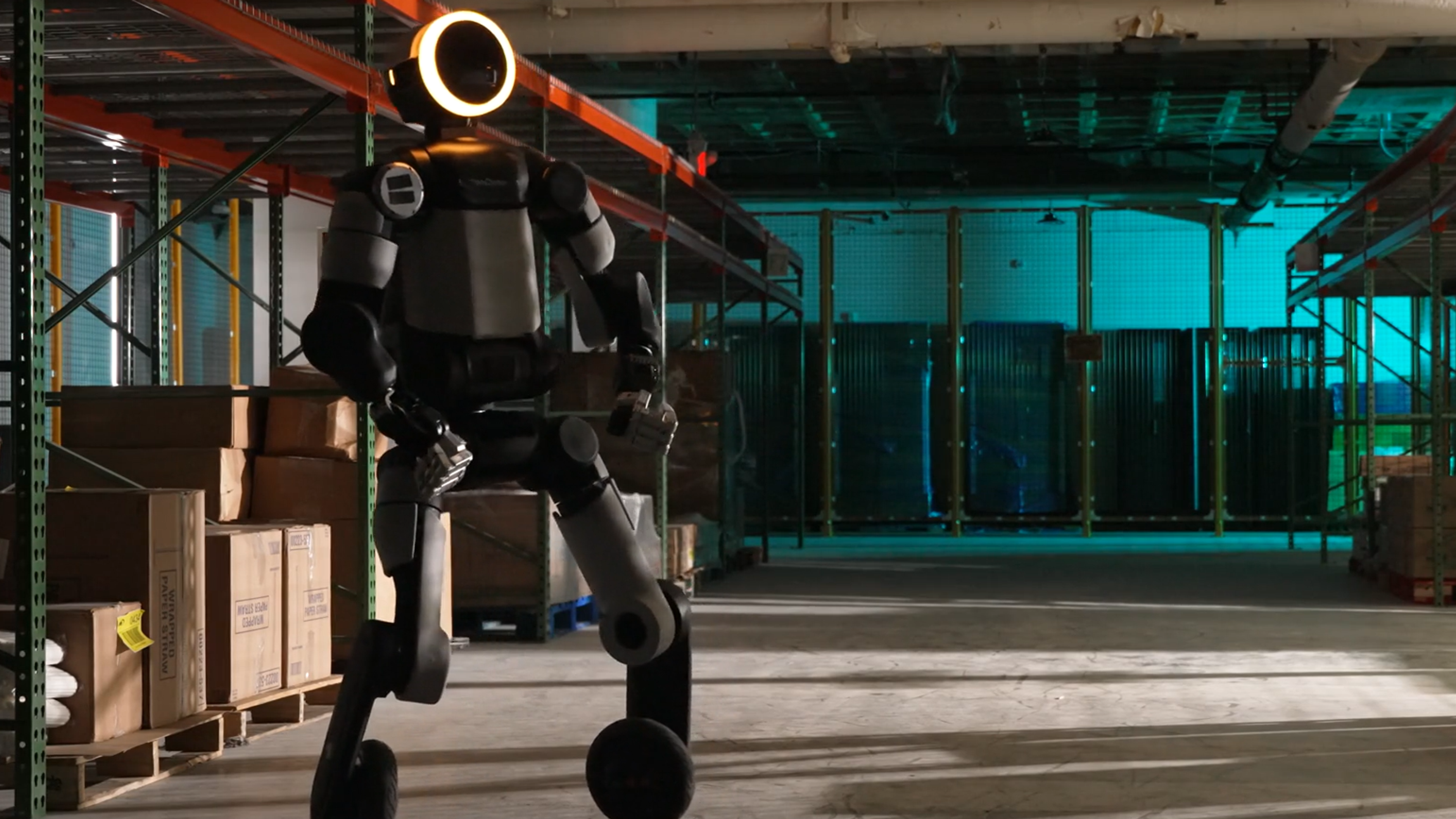
In a new blog post from Boston Dynamics’ engineering team, controls engineer Xiaoyu (Andy) Wu describes how the team replaced the feet of their Atlas humanoid with wheels in order to test out a learned whole-body controller on real motors, putting them through their paces in order to find out what they are truly capable of.
The company emphasizes that a wheeled Atlas is a testbed and not a product they intend to bring to market. To drive, the motors need to deliver high torque and high speed for extended periods of time while holding a real load. Launching, turning, and stopping a wheeled robot pushes the motors through their full torque-speed operating range, which which makes it a demanding test of how closely the simulation matches the hardware.
While simulating to research is a large portion of the work to train a robot with reinforcement learning, matching the simulation to the real hardware is equally important. Here they characterized the low-level control parameters for all software stacks used for Atlas, ran a series of characterization experiments on the hardware, and then tuned the motor model in the sim to match the data. Minor tweaks to the reward, to the commands that the policy trains on, and to how the policy holds the robot’s posture were also sufficient to get the robot to smoothly roll.
Several of the moves came from a library of human motion capture data such as side dashes with lots of foot sliding which seemed like they would change significantly when rolled by wheels. In the side dashes, the policy learned to steer the wheels and roll through the motion. In addition, a 360-degree jump, where a person jumps in a circle and then lands was tested. This worked on the first attempt and was recorded.
These lessons are immediately being applied to improve the standard configuration of Atlas and Andy’s next project, learning to handle failure of individual actuators using reinforcement learning policies.
The information comes from the organization itself and lacks many critical numbers (e.g. torque and speed) to determine just how close to the physical limit of the motors the robot was operating.
More articles on this topic
278 articles ReportWhat it Really Costs to Own a Personal Assistant Robot at Home
 ReportHumyn Labs Raises $47 Million to Build Real-World Training Data for Robotics
 ReportBoston Dynamics Selects GlobalFoundries as First Semiconductor Customer for Atlas Humanoid Trials
 ReportGenesis AI Raises $500 Million at a $3.5 Billion Valuation to Scale General-Purpose Robots
 ReportMultiway Robotics Showcases Intralogistics Solutions and Wheeled Humanoid at CeMAT ASIA
 ReportFORT Robotics Files Registration Statement for Public Listing Partnership
 ReportRobot Baristas are Learning to Reproduce the Art of Professional Coffee Making
 ReportTARSBOT and Aptiv Plan to Deploy 100 Industrial Robots Across 33 Factory Applications
 ReportSouth Korea Proposes $39 Million for Robot Actuators, Humanoid Batteries and AI Sensors
 ReportLoongson Completes ROS 2 Integration on Its Domestic Computing-Powered Intelligent Robot Vehicle
 ReportAnt Group Open-Sources LingBot-Touch to Give Robots a Shared Sense of Touch
 ReportArrive AI Invests in Ottonomy with Plans for 50 Autonomous Delivery Robots
BUSINESS NEWS WEEKLY LETTER
The Weekly Letter for Robotics Professionals, Summarizing the Most Important Industry Moves, Launches, Deals and Signals.