Beetle-Inspired Robot Walks and Grasps With Finger Controls Alone
Meet BeetleBot, a bug-sized robot that walks, turns and picks up objects using nothing but finger-controlled commands. Inspired by a beetle’s muscles and anatomy, it uses artificial muscles, a soft gripper and onboard sensors to navigate and report back.
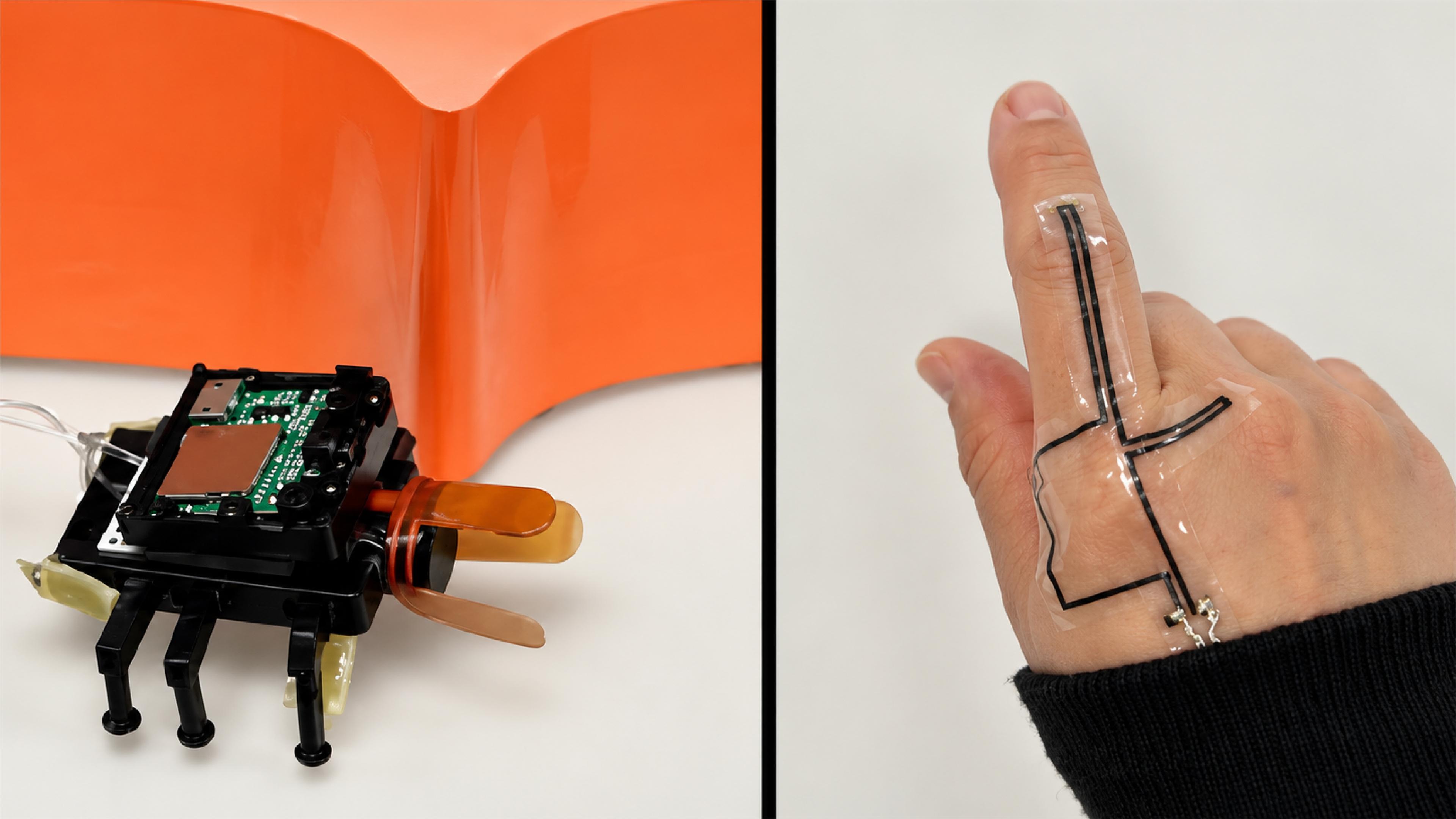
The world could very well be at our fingertips.
Meet BeetleBot, a tiny robot roughly the size of the bug. Inspired by a beetle’s anatomy and muscle movements, it was developed by researchers led by Professor Sang Ouk Kim at the Korea Advanced Institute of Science and Technology (KAIST), in collaboration with teams at Caltech in the US, and Nanyang Technological University in Singapore.
Muscles move this machine
Unlike conventional robots that rely on motors and mechanical linkages, BeetleBot uses artificial muscles made from a special material called liquid crystal elastomer. When heated by electricity, these muscles contract, allowing the robot to walk and turn left or right.
It walks, picks and reports
If its walking doesn’t impress you, the accuracy with which it picks things up surely will. Its soft gripper mimics a beetle’s mandibles, while a pressure sensor detects when it makes contact with an object. An onboard camera lets the operator see what lies ahead. So, BeetleBot doesn’t just act. It reports back, too.
Your finger is the controller
This is really where all the fun lies. A stretchable sensor patch worn on your finger detects when you bend or straighten it, and these movements translate into four commands. Move forward, turn left, turn right, and grip. The commands travel wirelessly to BeetleBot, while its camera and pressure sensor relay visual and touch information back to you.
So, is it ready for the real world?
Not quite yet. Researchers have demonstrated through experiments that BeetleBot can navigate obstacles, approach a target, grip it and carry it away, all under human control. But there’s still work to do. Its artificial muscles need to become faster and more energy-efficient, and its power supply needs improvement before practical deployment.
It may not be long before this little, bug-sized machine can help inspect tight spaces inside industrial equipment, retrieve small objects from hard-to-reach places or explore environments that are difficult for humans to access.
And for a little bot gearing up to take on big feats, the signs are promising. This beetle just might not let us down.
More articles on this topic
278 articles ReportWhat it Really Costs to Own a Personal Assistant Robot at Home
 ReportHumyn Labs Raises $47 Million to Build Real-World Training Data for Robotics
 ReportBoston Dynamics Selects GlobalFoundries as First Semiconductor Customer for Atlas Humanoid Trials
 ReportGenesis AI Raises $500 Million at a $3.5 Billion Valuation to Scale General-Purpose Robots
 ReportMultiway Robotics Showcases Intralogistics Solutions and Wheeled Humanoid at CeMAT ASIA
 ReportFORT Robotics Files Registration Statement for Public Listing Partnership
 ReportRobot Baristas are Learning to Reproduce the Art of Professional Coffee Making
 ReportTARSBOT and Aptiv Plan to Deploy 100 Industrial Robots Across 33 Factory Applications
 ReportSouth Korea Proposes $39 Million for Robot Actuators, Humanoid Batteries and AI Sensors
 ReportLoongson Completes ROS 2 Integration on Its Domestic Computing-Powered Intelligent Robot Vehicle
 ReportBoston Dynamics Puts Wheels on Atlas Humanoid to Test Reinforcement Learning and Motor Limits
 ReportAnt Group Open-Sources LingBot-Touch to Give Robots a Shared Sense of Touch
BUSINESS NEWS WEEKLY LETTER
The Weekly Letter for Robotics Professionals, Summarizing the Most Important Industry Moves, Launches, Deals and Signals.