Meet China’s Robot Cops: No Gun, No Arrests, No Coffee Breaks
In Hangzhou, robots are now the ones telling you to buckle up, back off the stop line and put your helmet on.

September 2, 2026 by Vaishnavi
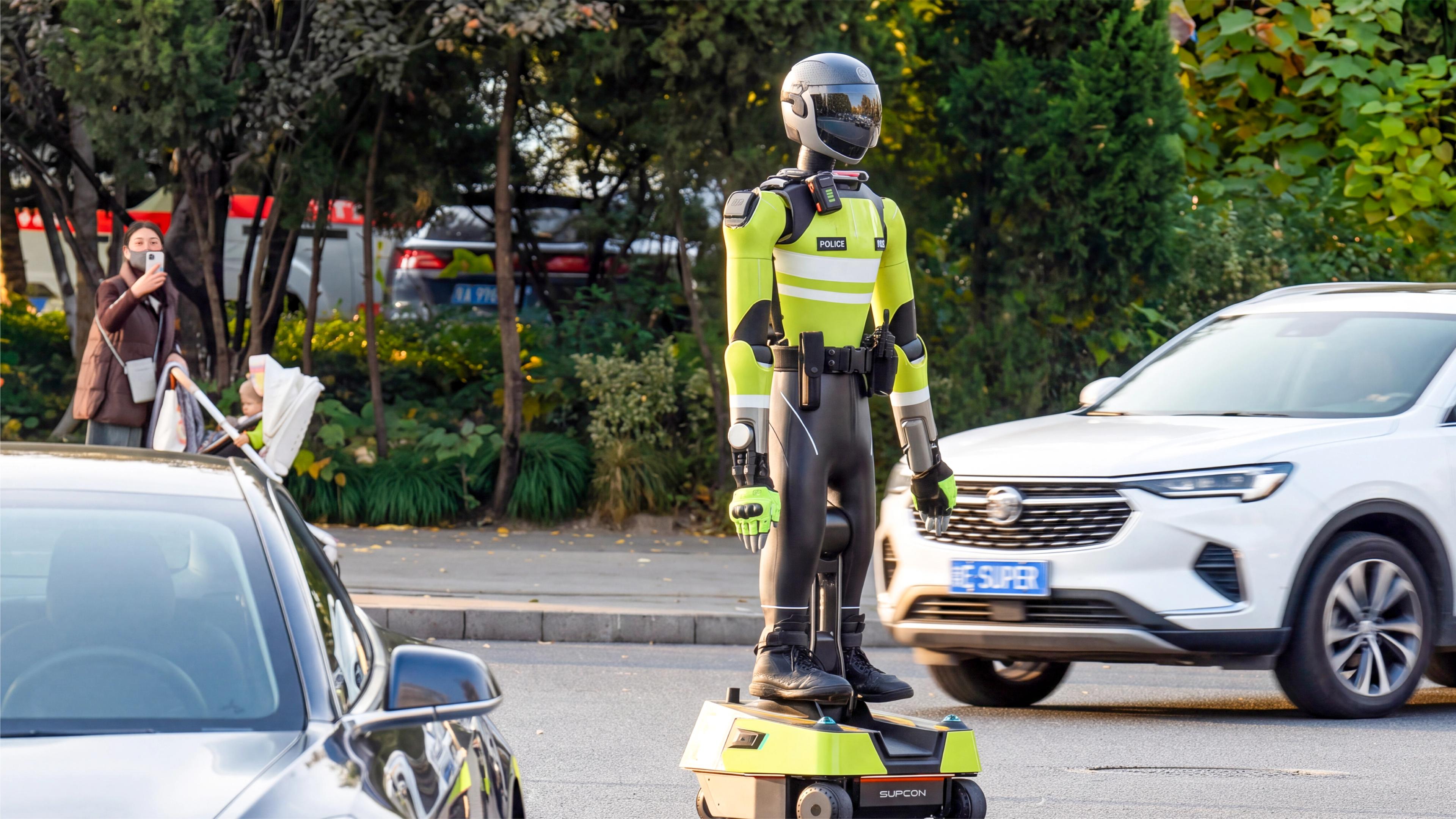
Fifteen robots have been directing traffic and assisting pedestrians around Hangzhou's West Lake district, forming what Chinese state media has described as the country's first dedicated robot traffic enforcement squad.
The robots, built by local technology firm SUPCON Information, stand 1.88 meters tall and weigh 98 kilograms. Known as the T2, they use cameras, radar, and onboard computing to identify riders without helmets, e-bikes carrying passengers, vehicles stopping over marked lines, and pedestrians crossing against signals, according to Cao Hui, head of SUPCON's intelligent unmanned systems innovation center.
The units run autonomously from 7 a.m. to 6 p.m., moving between preset intersection positions without remote control, while a central platform lets human traffic police monitor and dispatch them. The robots have no gun and no power to arrest and move on wheels.
SUPCON says the 15 robots have issued more than 170,000 warnings and have helped cut helmetless riding and stop-line violations by more than 40%. The company also says its violation-recognition accuracy exceeds 95%, though it acknowledges cameras and radar can still be affected by strong sunlight, rain, and extreme temperatures.
Beyond traffic duties, the robots answer questions about directions, public transport, and emergency reporting. Their arm gestures are synchronized to intersection signal cycles at the millisecond level.
Deployment focus varies by location. Robots near tourist sites such as West Lake and the city zoo concentrate on pedestrian guidance. Those at intersections focus more on flagging illegal parking, helmet violations, and overloading.
That said, Hangzhou is not the only Chinese city doing this; a few other cities have their own versions. Chengdu introduced a mixed team of quadruped, wheeled, and humanoid robot officers; Shenzhen has used EngineAI's PM01 for patrols; and a robot in Wuhu, Anhui province, has issued cycling safety reminders.
Little is known about expansions to other cities because it would require adapting the robots to local law enforcement IT systems, obtaining certifications, and complying with data protection rules. Furthermore, the machines also carry cameras and other sensors.
More articles on this topic
156 articles ReportOctopus-Inspired Muscle Design Simplifies Dexterous Soft Robots
 Report5 Jobs Robots Could Take Over by 2035 — And 5 They’ll Struggle to Replace
 ReportNvidia Develops Safety Controls as AI Advances Into Robotics
 ReportWhy aren't robots in our homes yet?
 ReportFlourish Opens Preorders for $3,555 Trainable Home Robot
 ReportHow Do Robots See the World?
 Report6 Unusual Jobs Done By Robots
 ReportRLWRLD Expands Physical AI Push for Industrial Robots
 ReportCircus SE Partners With Royal Prestige for UAE Food-Robot Launch
 ReportSix Giant Robots from Around the World
 ReportThree Real Robots Inspired by Star Wars
 ReportJobs You Didn't Know Were Done by Robot Dogs
BUSINESS NEWS WEEKLY LETTER
The Weekly Letter for Robotics Professionals, Summarizing the Most Important Industry Moves, Launches, Deals and Signals.