Octopus-Inspired Muscle Design Simplifies Dexterous Soft Robots
The system selectively activates sections of a continuous actuator, allowing one structure to produce several controlled movements.

October 3, 2026 by Artem
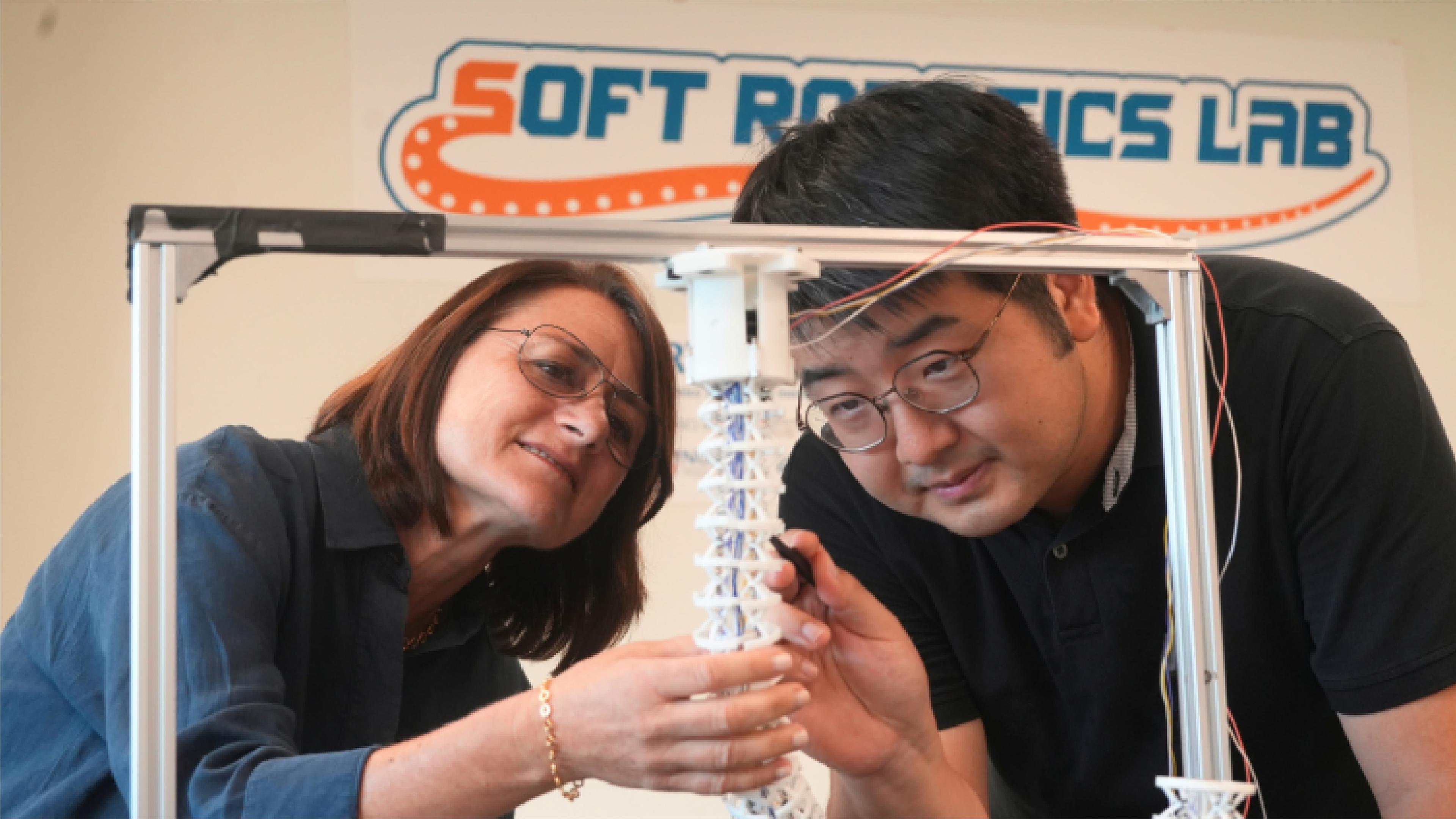
SINGAPORE — Researchers at the National University of Singapore have built a soft robotic arm inspired by octopus muscles that can produce multiple controlled bends using a single continuous artificial muscle, reducing the number of separate actuators needed for complex motion.
Instead of installing an actuator at each controllable section, the researchers placed a single shape‑memory‑alloy spring with electrical contact points. It lets different segments contract independently and reduces the number of actuators and simplifying control, according to a report, published in Science Advances.
The research was led by Cecilia Laschi, a professor of mechanical engineering at NUS and director of the NUS Advanced Robotics Centre and Soft Robotics Lab. Laschi and Wenci Xin, a former doctoral student at the lab and the paper's first author, are pictured with the robotic arm in the accompanying photo.
The researchers took inspiration from the neural pathways that stimulate specific areas within an octopus's arms. An octopus can bend one part of an arm around an obstacle while using another section to reach for an object without the rigid joints found in many robots.
In one prototype, four continuous actuators controlled six sections of the arm. Xin estimated the conventional design would need about 24 motors; this is an approximation, not based on a 24-motor comparison.
In tests on two 10‑cm arms, the continuous design bent 91° while the stacked design bent 46° under the same driving conditions. Computer modeling estimated its tip could extend to almost three times the space the conventional arm could reach.
The architecture also lets researchers exchange movement complexity for energy use. Controlling the full length as a single section consumed 40% less energy than controlling four segments independently, while separate activation allowed more bends to navigate around obstacles.
The researchers also built a 0.6-meter arm-and-gripper system that could be carried beneath a drone. Different sections of the actuators bent the arm, operated its gripper and moved a syringe plunger for liquid sampling.
With its supporting equipment included, the robotic attachment weighed about 450 grams. In demonstrations at a simulated hard-to-access location, it collected liquid and solid samples through a 2-centimeter-high opening and retrieved objects while suspended beneath the drone.
The system is still research hardware, not yet a deployed robot. The team plans to study different spring geometries and heat-responsive materials. They will also add built-in air cooling to increase force and shorten cooling time between movements.
More articles on this topic
39 articles ReportRobots vs. Drones: What Is the Real Difference?
 ReportHow Animals Inspire Better Robots
 ReportFrom Toys to Tools: The Coolest Robots in Schools Today
 ReportThis Tiny Robot Hops Like a Frog And Swims Using Elastic Limbs
 ReportJapan Tests Robot Bins at Tokyo’s Busiest Railway Station
 Report5 Jobs Robots Could Take Over by 2035 — And 5 They’ll Struggle to Replace
 ReportNvidia Develops Safety Controls as AI Advances Into Robotics
 ReportWhy aren't robots in our homes yet?
 ReportFlourish Opens Preorders for $3,555 Trainable Home Robot
 ReportHow Do Robots See the World?
 ReportFive Extreme Sports Where Robots Are Competing
 Report6 Unusual Jobs Done By Robots
BUSINESS NEWS WEEKLY LETTER
The Weekly Letter for Robotics Professionals, Summarizing the Most Important Industry Moves, Launches, Deals and Signals.