The Rise of the Mechanical Zoo
Innovative attractions swapping live cages for hyper-realistic engineering, proving the future of wildlife is fully mechanical.
For centuries, traditional zoos have operated on a simple premise: removing wildlife from their natural habitats and placing them in cages for public entertainment. Today, however, breakthroughs in technology and bio-robotics are challenging this conventional model through the rise of the mechanical zoo.
These high-tech attractions are gaining massive appeal because they prove we can still inspire awe and educate the public without the ethical downsides of captivity and ecosystem disruption. From permanent installations and traveling exhibitions to cutting-edge marine engineering labs, the promising results of this robotic revolution are already on display worldwide.
1. The Titanium Shark: Xiaomeisha Sea World, Shenzhen
The robotic whale shark tops this list because it represents a technological win over public expectation. When the marine park reopened after a five-year renovation, crowds swarmed the venue to see its star attraction: a massive whale shark gliding through the primary tank. Only to learn that it is a highly sophisticated, 4.7-meter-long robot designed from advanced titanium alloy and stainless steel. The park’s authorities defended their multi-million yuan robot, noting that shark trade is illegal and putting them in cages is simply cruel. Xiaomeisha Sea World clarified that "the robotic whale shark was not intended to deceive visitors, but rather to comply with laws prohibiting the capture and trade of whale sharks."
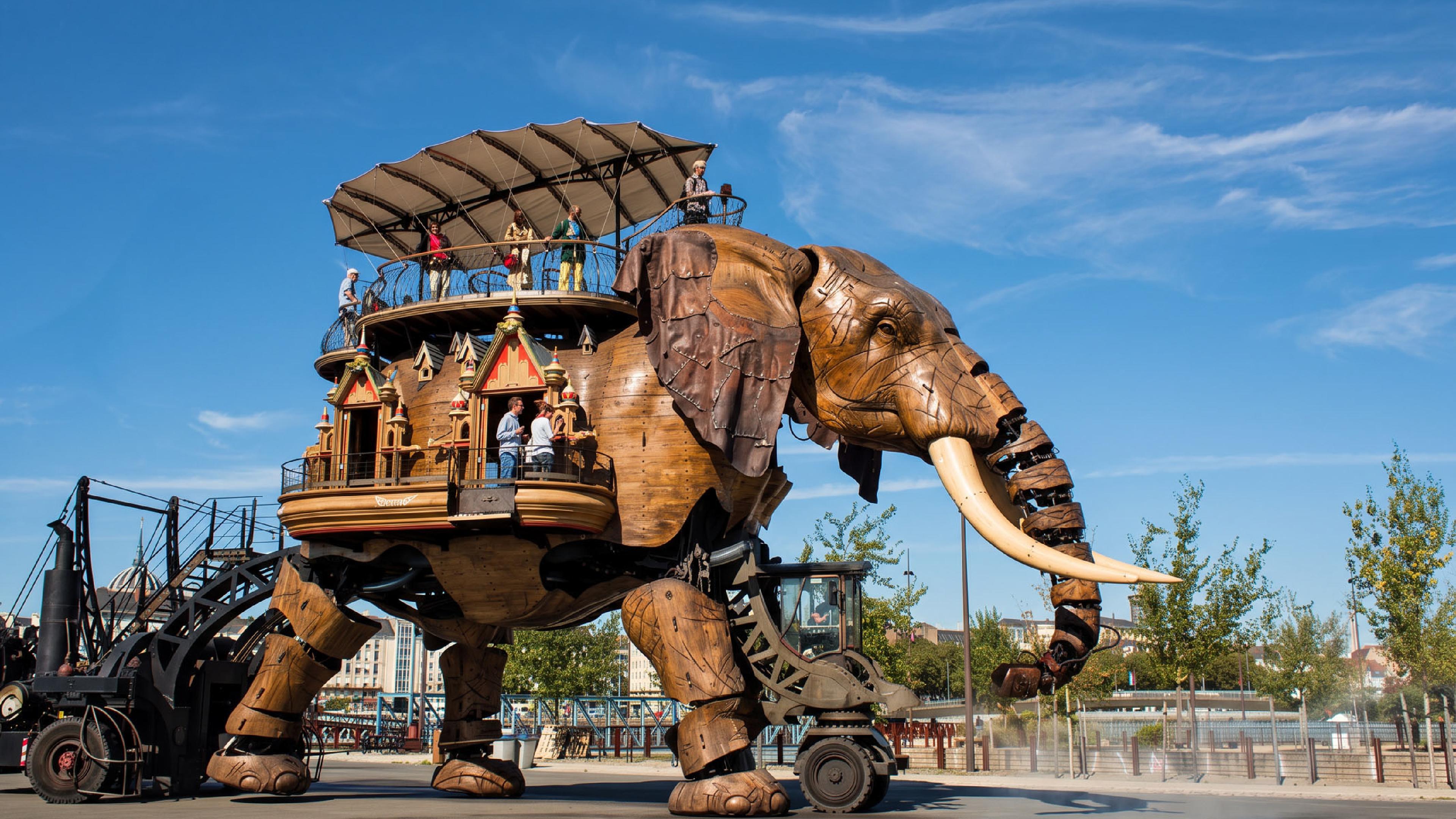
2. The Grand Éléphant of Nantes, France
Les Machines de l’île in Nantes, France, offers a surreal, open-air mechanical safari. Its star attraction is a 12-meter-tall, 48,000-kilogram robotic elephant engineered from steel and tulipwood. This mechanical marvel roams the city's historic shipyards, carrying up to 50 passengers and spraying water from its trunk. This unique destination has become a massive hit by blending rich industrial history with pure fantasy, perfectly capturing a vibe where Leonardo da Vinci meets Jules Verne.
3. Edge Innovations Introducing Robot Dolphins
The push for robotic animals is moving fast, reshaping the future of marine entertainment. Edge Innovations, a California company founded by Walt Conti, has engineered a spectacular, life-size robotic bottlenose dolphin. This 250-kilogram robotic colossus can cruise the water for 10 hours straight on a single charge. Covered in medical-grade silicone skin, its lifelike appearance is completely seamless—leaving audiences hard-pressed to tell it apart from a real dolphin. The innovation caught the eye of Chinese retail giant Red Star Macalline, which originally planned to put these robots into mall aquariums. Capturing the vision behind the project, Conti observed: "With around 3,000 dolphins held in captivity, there's obviously an appetite to love and learn about dolphins."
4. The Robot Zoo - Science World Vancouver
The upcoming Science World Vancouver's "The Robot Zoo" exhibition (October 9 to April 4, 2024) is the talk of the town. Unlike common robot zoo venues, this exhibition takes over other live shows with eight oversized mechanical creatures.
The exhibition features a giant platypus performing the breaststroke, a grasshopper launching itself into a jump, and a mechanical squid hunting its prey. The core objective of this exhibition is to teach biomechanics with nothing alive on display. It transforms biological muscles into mechanical pistons and animal brains into computers.
A Win-win: Conversation & Entertainment
Over the years, the debate against traditional zoos has grown harsh, focusing on the psychological toll captivity takes on wild animals. Conversely, the arguments against robotic zoos usually come down to cost and technology. Creating a hyper-realistic robot requires an immense upfront investment.
However, mechanical animals do not require specialized diets, veterinary teams, massive habitats, or continuous climate control. They do not get sick, they do not age, and they present zero safety risks to handlers or visitors. Most importantly, a mechanical zoo fulfills the exact same educational and entertainment goals as a traditional zoo without a single compromise on animal welfare. The future of wildlife entertainment is not wild at all; it is engineered.
More articles on this topic
278 articles ReportWhat it Really Costs to Own a Personal Assistant Robot at Home
 ReportHumyn Labs Raises $47 Million to Build Real-World Training Data for Robotics
 ReportBoston Dynamics Selects GlobalFoundries as First Semiconductor Customer for Atlas Humanoid Trials
 ReportGenesis AI Raises $500 Million at a $3.5 Billion Valuation to Scale General-Purpose Robots
 ReportMultiway Robotics Showcases Intralogistics Solutions and Wheeled Humanoid at CeMAT ASIA
 ReportFORT Robotics Files Registration Statement for Public Listing Partnership
 ReportRobot Baristas are Learning to Reproduce the Art of Professional Coffee Making
 ReportTARSBOT and Aptiv Plan to Deploy 100 Industrial Robots Across 33 Factory Applications
 ReportSouth Korea Proposes $39 Million for Robot Actuators, Humanoid Batteries and AI Sensors
 ReportLoongson Completes ROS 2 Integration on Its Domestic Computing-Powered Intelligent Robot Vehicle
 ReportBoston Dynamics Puts Wheels on Atlas Humanoid to Test Reinforcement Learning and Motor Limits
 ReportAnt Group Open-Sources LingBot-Touch to Give Robots a Shared Sense of Touch
BUSINESS NEWS WEEKLY LETTER
The Weekly Letter for Robotics Professionals, Summarizing the Most Important Industry Moves, Launches, Deals and Signals.