Tiangong Ultra Smashes Humanoid 100-Meter Record with 8.64-Second Run
The Chinese humanoid posted three progressively faster times in Beijing, but its uncontrolled finish showed that sprint speed and useful mobility remain separate engineering problems.

September 3, 2026 by Vismay
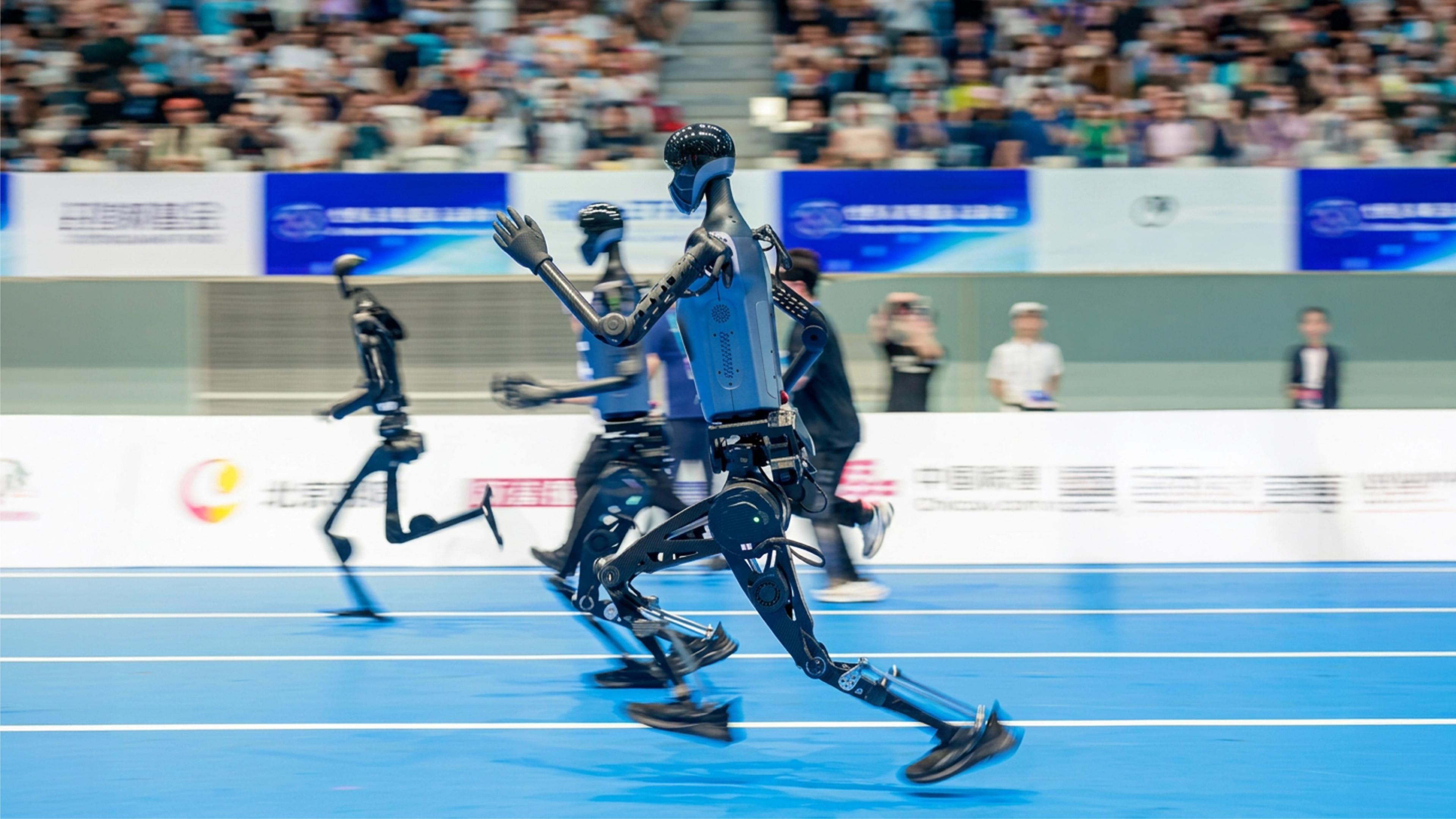
BEIJING: Tiangong Ultra, developed by Beijing Humanoid Robot Innovation Center has completed a 100-meter race in 8.64 seconds recently, setting the fastest reported time for a humanoid robot and winning the large-size division at the World Humanoid Robot Games.
The result lowered the 8.86-second mark the robot recorded in the semifinal one day earlier. Tiangong Ultra also known as X-Humanoid had opened the competition with a 9.39-second run, giving it three progressively faster times during the five-day event, according to Reuters.
The developer attributed enhanced performance to upgraded joint motors, cooling, weight reduction and control algorithms, Beijing Youth Daily reported. However, it has not released detailed test data showing how much each change contributed.
The 8.64-second result is numerically 0.94 seconds faster than Usain Bolt’s 9.58-second men’s world record, recognized by World Athletics. It is noteworthy that the comparison is not exactly like-for-like as it is not governed by human athletics rules.
The Associated Press reported that Tiangong Ultra and several other runners crashed into a padded barrier beyond the finish line.
Sparks came from some robots, prompting track workers to use fire extinguishers. Almost all the runners were carried from the track.
Tiangong Ultra encountered a similar problem after its 8.86-second semifinal. The robot struck a thick stopping mat, collapsed and developed a small fire in its torso, Reuters reported. Another robot came apart during the other semifinal.
Robots had to operate autonomously without remote control in all track and other competitive events except the 100-meter and 400-meter obstacle races, according to an event summary published by the Beijing municipal government.
Over 2,000 robots from 666 teams entered 51 disciplines at the Games, including sports and simulated factory, restaurant, household and emergency tasks. Jonathan Hurst, an Oregon State University robotics professor, told AP that more meaningful progress would be measured by robots performing useful work autonomously for hours.
As for the Beijing games, even the fastest humanoids still depended on barriers and trackside crews to stop safely.
More articles on this topic
156 articles ReportOctopus-Inspired Muscle Design Simplifies Dexterous Soft Robots
 Report5 Jobs Robots Could Take Over by 2035 — And 5 They’ll Struggle to Replace
 ReportNvidia Develops Safety Controls as AI Advances Into Robotics
 ReportWhy aren't robots in our homes yet?
 ReportFlourish Opens Preorders for $3,555 Trainable Home Robot
 ReportHow Do Robots See the World?
 Report6 Unusual Jobs Done By Robots
 ReportRLWRLD Expands Physical AI Push for Industrial Robots
 ReportCircus SE Partners With Royal Prestige for UAE Food-Robot Launch
 ReportSix Giant Robots from Around the World
 ReportThree Real Robots Inspired by Star Wars
 ReportJobs You Didn't Know Were Done by Robot Dogs
BUSINESS NEWS WEEKLY LETTER
The Weekly Letter for Robotics Professionals, Summarizing the Most Important Industry Moves, Launches, Deals and Signals.