PUDU ET1 vs. KEENON KLEENBOT C20
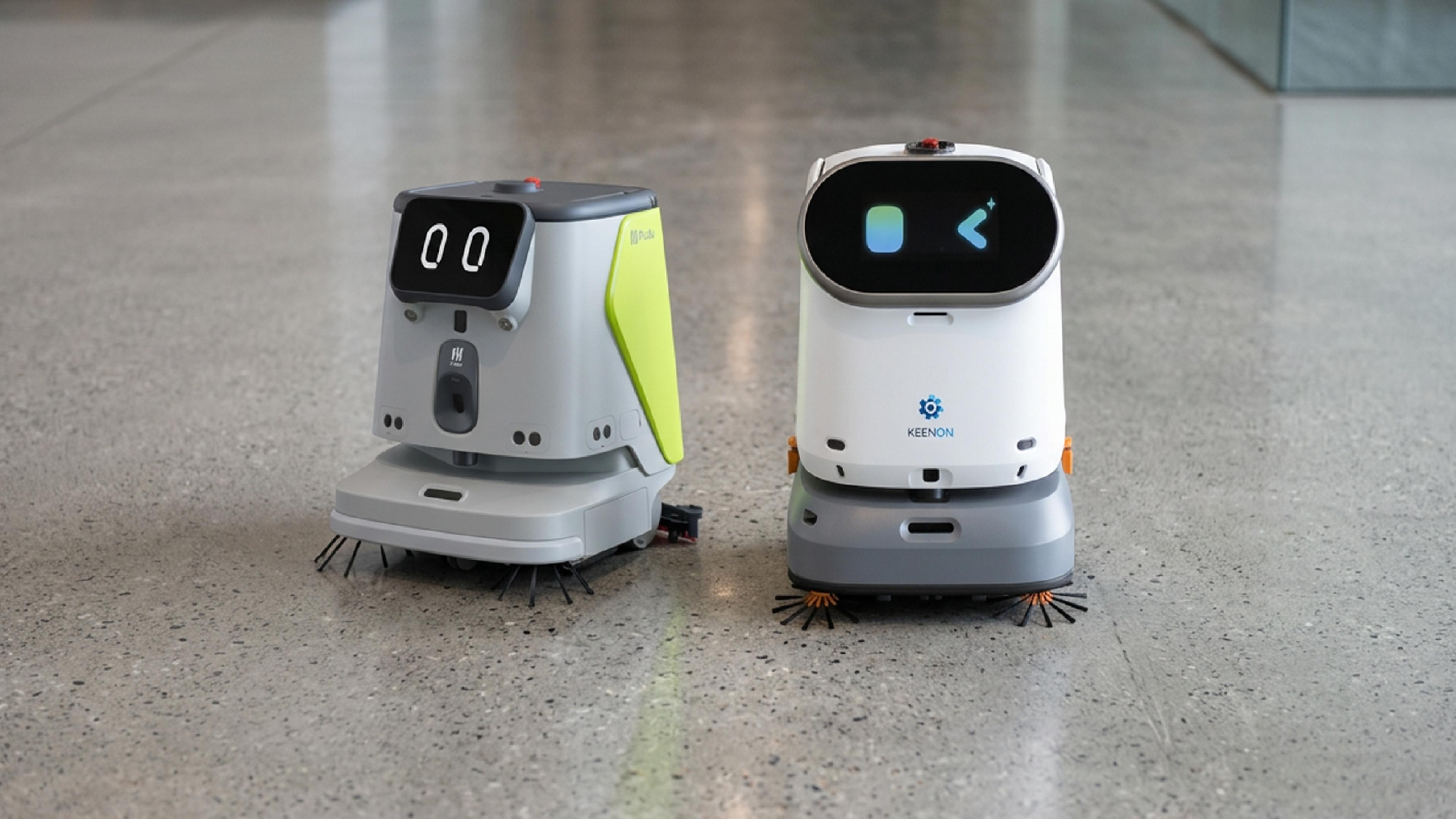
PUDU ET1 and KEENON KLEENBOT C20 are compact commercial cleaning robots designed for smaller indoor spaces. Both support multiple floor-cleaning functions, but differ in cleaning width, battery endurance, automation and maintenance capabilities. We compare their specifications and suitability for retail, hospitality and facility maintenance.

November 19, 2026 by Business Desk Team
Introduction
Cleaning robots are becoming increasingly popular among small commercial areas where big robots may face difficulties in passing through narrow aisles and overcrowded areas.
PUDU ET1 and KEENON KLEENBOT C20 are examples of small cleaning robots that can be applied in such situations.
PUDU ET1 robot combines sweeping, vacuuming, scrubbing and dust-mopping with the help of artificial intelligence technology for automatic stain recognition and maintenance station. This model is intended for cleaning commercial area size about 100-800 m².
KEENON KLEENBOT C20 robot combines sweeping, vacuuming and mopping functions in one robot platform for daily hard-floor maintenance needs. Also, it allows managing tasks remotely and creating reports after cleaning.
These robots have a similar application, but there are some differences in cleaning capabilities, size and automation features.
With the help of information provided by ROBOT24.com from market research data records and manufacturers’ specification sheets, the comparison will be made.
At a Glance
| Metric | PUDU ET1 | KEENON KLEENBOT C20 |
|---|---|---|
| Availability | COMMERCIALLY AVAILABLE | Commercially Available |
| Nationality | China | Chinese |
| Typical use | Cleaning & Facility Maintenance, Retail & Showroom Operations, Hospitality | Cleaning & Facility Maintenance |
| Status | Commercial | Commercial |
| Dimensions | 500 × 380 × 580 mm | 523 × 400 × 351 mm |
| Weight | Approximately 45 kg | 22 kg |
| Cleaning width — sweeping/vacuuming | 390 mm | 450 mm |
| Cleaning width — scrubbing/mopping | 300 mm | 285 mm |
| Maximum cleaning efficiency | 720 m²/h | 400 m²/h |
| Runtime | 2.5–4 hours | Up to 4 hours |
| Charging time | Approximately 3 hours | 3 hours |
| Clean water tank | 8 L | 7 L |
| Wastewater tank | 7.2 L | 5 L |
How They Compare
Capabilities of floor cleaning
Both cleaning robots unite several functions of cleaning operations in one device. PUDU ET1 can sweep, vacuum, scrub and dust mop floors. Thanks to its front sweeping and rear scrubbing, it deals with both dry and wet floors.
KEENON KLEENBOT C20 is able to sweep, vacuum and mop floors. The latter includes separate tanks for clean and wastewater. ET1 is capable of floor and stain recognition by using artificial intelligence. Depending on the recognition, cleaning parameters can be adjusted automatically.
Thanks to the hot-water scrubbing system, this robot cleans floors heated up to 85°C and eliminates difficult stains. Some of the mentioned functions can be useful in retail and restaurant establishments where conditions change throughout the day.
Cleaning width and efficiency
Width of sweeping and vacuuming performed by PUDU ET1 is 390 mm, and width of scrubbing – 300 mm.
KEENON C20 provides wider sweeping and vacuuming of 450 mm together with 285 mm of scrubbing width.
In this case, C20 has an advantage of 60 mm in sweeping width while ET1's width of scrubbing is wider. However, PUDU ET1 has higher maximum efficiency of cleaning of 720 m²/h compared with C20's 400 m²/h.
These efficiency values may vary due to different conditions of testing and cannot be considered as actual values in real-world environment.
Size and maneuverability
Both robots are designed to be used in smaller commercial establishments. The dimensions of PUDU ET1 are 500 × 380 × 580 mm and weight is about 45 kg.
Dimensions of KEENON C20 are 523 × 400 × 351 mm and weight is 22 kg. In this case, C20 has an obvious advantage in weight and length of the device. These parameters can be useful for establishments that have some low-clearance areas. PUDU ET1 has narrower recorded width of the body and it is designed to move through corridors with minimum width of 50 cm and minimum height of 60 cm.
KEENON C20 is designed in such a way that its compactness allows it to perform tasks in restricted indoor areas. Physical characteristics of robots do not mean better maneuverability; it depends also on navigation and obstacle avoidance.
Battery endurance and charging
Runtime of PUDU ET1 varies from 2.5 to 4 hours depending on operating conditions. KEENON C20 has a maximum runtime of four hours.
Maximum charging time in both cases is approximately three hours. Thus, maximum operating duration of these robots is approximately the same. The supplied manufacturer specifications do not give any obvious advantage in battery endurance.
Automation and maintenance
One of the distinctive features of ET1 is its automatic maintenance station.
PUDU's 8-in-1 dock station allows performing automatic recharging, refilling of clean water, waste water discharge, detergent dosing, roller cleaning, squeegee rinsing, roller drying and water heating. In addition, ET1 supports automatic dust collection and real-time roller-mop cleaning.
These features are designed to decrease frequency of maintenance performed manually. The emphasis of KEENON C20 is put on modular cleaning system with easy-accessible tanks, brushes and other cleaning parts.
The management software provides possibility of task scheduling, remote dispatching, monitoring of operation status and cleaning reports via application or web interface. According to manufacturer specifications, C20 does not have an automated maintenance station.
Commercial applications
Both robots are designed for floor cleaning in commercial establishments. PUDU ET1 is designed for convenience stores, pharmacies, restaurants, hotels and offices. Additionally, it has an option of 21.5 inch advertisement display and can be used for promotion in retail environments.
KEENON C20 performs daily hard floor cleaning in compact commercial establishments. Features of automated cleaning and maintenance in ET1 can attract establishments where less manual intervention in cleaning process is needed.
Compact design of C20 can be attractive for establishments where compact cleaning robot is needed. However, the best robot depends on specific cleaning needs, space available and maintenance requirements.
Commercial availability
Both robots are commercially available according to the supplied records. But there may be some differences in regional stock, installation, warranty terms and after-sales service. Before buying either robot, businesses should check their local distributor availability and total cost of ownership.
Summary
PUDU ET1 and KEENON KLEENBOT C20 are compact autonomous floor cleaning robots designed for commercial facility maintenance.
ET1 has such unique features as artificial intelligence-based recognition of floor condition and stains, hot water scrubbing and an automated maintenance station. In addition, it has higher manufacturer-stated maximum cleaning efficiency value.
C20 has advantages in its lighter and shorter body and wider sweeping and vacuuming width. Maximum runtime and charging time are similar in both robots.
Both robots may be useful for compact commercial establishments, but they have different features.
PUDU ET1 is more attractive for business that need automation and minimal maintenance. On the other hand, C20 can be chosen by business needing lighter and lower robot for hard-floor cleaning.
None of these robots can be declared as the winner in performance according to the specifications.
This comparison is based on ROBOT24.com market research data records and manufacturer specifications. Actual cleaning performance, battery endurance and maintenance requirements should be evaluated under comparable operating conditions.
More articles on this topic
167 articles ReportRichtech DUST-E S vs. Gausium Phantas
 ReportEngineAI SE01 vs. AGIBOT RAISE A1ReportRichtech DUST-E S vs. KEENON KLEENBOT C20
 ReportPUDU FlashBot vs. KEENON DINERBOT T3
 ReportPUDU CC1 Pro vs. KEENON KLEENBOT C40
 ReportUniRing MAX vs. KEENON KLEENBOT C40
 ReportAGIBOT X2 vs. Unitree R1
 ReportPUDU CC1 vs. UniRing MAX
 ReportPUDU KettyBot vs. KEENON DINERBOT T8
 ReportPUDU KettyBot Pro vs. KEENON DINERBOT T9 Pro
 ReportPUDU CC1 vs. KEENON KLEENBOT C55 vs. UniRing MAX
 ReportCleanfix S170 Navi vs. SoftBank Robotics Whiz vs. KEENON KLEENBOT C30
BUSINESS NEWS WEEKLY LETTER
The Weekly Letter for Robotics Professionals, Summarizing the Most Important Industry Moves, Launches, Deals and Signals.